Your Joy is Your Sorrow Unmasked – Kahlil Gibran

Your joy is your sorrow unmasked

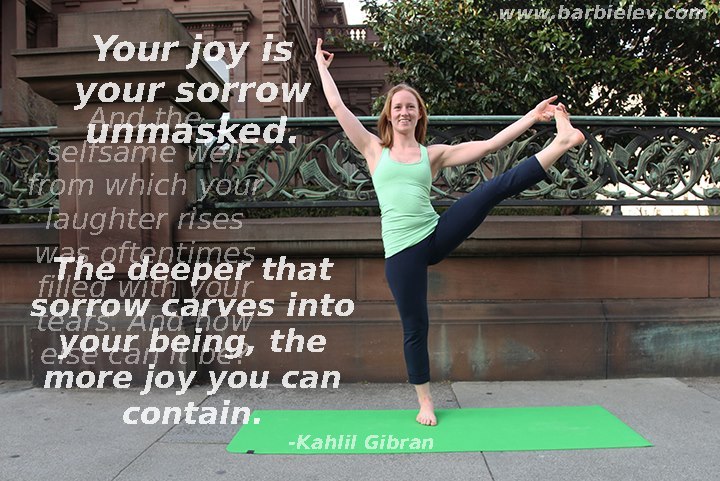
Your joy is your sorrow unmasked. And the selfsame well from which your laughter rises was oftentimes filled with your tears. And how else can it be? The deeper that sorrow carves into your being, the more joy you can contain.

The first time I read this passage from The Prophet by Kahlil Gibran I was seventeen. It was it was translated into French as part of a high school exam and I was prompted to write my thoughts on the passage. Here’s what I wrote (translated from French):

The text says “your joy is your sadness unmasked,” meaning the two are fundamentally the same sentiment. They come from the same place in the heart. We feel joy when we react positively to this base emotion, and sadness when we react negatively.

The more sadness we have suffered, the more joy we are capable of feeling. We must experience the bad to be able to appreciate the good. This works the other way as well: the more joy that we have felt, the more sadness we can suffer; especially if we suddenly lose the cause of our joy. In this case, the fact that we have known joy causes our sadness.

Things, people, or events that make us sad are often things, people or events that make us joyful. If we love someone and they hurt us, it causes much more sadness than if someone that we don’t care about hurts us. If we do something that brings us joy with someone, and then this person leaves or dies, the same activity makes us think of this person’s departure, and consequently makes us sad.

Sadness and joy come together; they are in equilibrium. But, that’s only true to a point, because we must be capable of raising their levels, we must have either joy or sorrow become stronger than the other for a period of time. These boosts are caused by significant events in life. When we open our hearts so we can feel more joy, we also open up to sadness. We cannot avoid it. If we want to feel joy at the most intense level, we must suffer the equal and opposite emotion.

The only way to not feel sadness it to feel nothing, and that it not worth it. If we were capable of eliminating sadness, there would be no joy and we would have equilibrium: nothing and nothing are easy to balance.

Ever feel like you knew more as a teen than people gave you credit for?

What is the path to enlightenment?

Q: What is the path to enlightenment?

A: According to Putanjali’s Yoga Sutras, enlightenment is attained in seven stages. Including the final stage, these form the Eight Limbs of Yoga:

1. Yamas: Hindrances (Nonviolence, Truthfulness, Nonstealing, Moderation, Non-possessivenes)
2. Niyamas: Oberservances (Purity, Contentment, Self-discipline, Self-study, Surrender)
3. Asana: Poses
4. Pranayama: Control of life-force through breath
5. Pratyahara: Withdrawal of the senses
6. Dharana: Concentration
7. Dhyana: Meditation
8: Samadhi: Non-dualistic consciousness

The last three limbs are so similar and seamless that Putanjali groups them together as samyama (perfectly controlled). Still, they are distinct stages:

Concentration (dharana) is binding the attention of the mind to a single object, place, or idea. Meditation (dhyana) is the continuous flow of consciousness toward an object. Samadhi is deep absorpotion on the object without thought of the self. Then, the essential nature of the object shines forth. (3.1-3.3) Through mastery of samyamah, knowledge born of intuitive insight shines forth. (3.5)

Even in the workout-focused yoga classes of the West, breadcrumbs that lead you along the path are still there. In public yoga classes, the focus is often on asana, the poses, and sometimes pranayama, the breath, but if you listen carefully, the other limbs of yoga are often threaded through many teachers’ cues. When yoga teachers suggests you avoid pushing so hard that you’re gasping for breath, they are talking about non-violence, one of the yamas. When they remind you to be happy in your variation on the pose, rather than grasping for the variation the person beside you is taking, they are talking about contentment, one of the niyamas. When teachers tell you focus the eyes and the mind on a drishti, a focal point, during balancing poses, they are talking about pratyahara, withdrawal of the senses. When you hear cues about detaching yourself from mental chatter and keeping your focus on your breath during savasana, corpse pose, your teachers are talking about samayama, the last three limbs.

All of this said, Putanjali’s system is only one way to journey toward enlightenment. There are many other paths.

About Barbie

About Barbie: Barbie has eight years experience teaching yoga. She promotes joy and presence in her classes by making them challenging but achievable; entertaining but uncomplicated; and accessible (not too much Sanskrit!) without losing touch with tradition. Her academic background is complemented by the spiritual nature of her yoga teacher trainings, making her uniquely qualified to host yoga classes that promote harmony of the body, mind, and spirit. More about Barbie >>