Cherish your visions; cherish your ideals…

Cherish your visions; cherish your ideals...

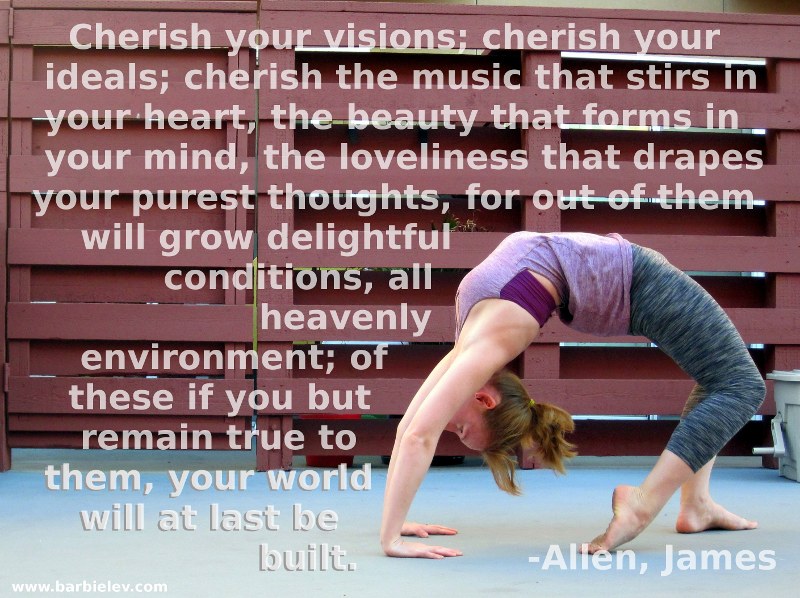
Cherish your visions; cherish your ideals; cherish the music that stirs in your heart, the beauty that forms in your mind, the loveliness that drapes your purest thoughts, for out of them will grow delightful conditions, all heavenly environment; of these if you but remain true to them your world will at last be built. – Allen, James

At the beginning of your yoga practice, cup your hands in front of your chest with palms facing upward. Imagine you’re holding a small pile of sand. The grains of sand you’re caressing represent your visions, your ideals, the music that stirs in your heart, the beauty that forms in your mind, and the loveliness that drapes your purest thoughts. Take a couple breaths to allow these individual grains to coalesce together to form an intention for your practice. It doesn’t have to be something that can be put into words. Exhale all the air from your lungs, and then inhale through the mouth, breathing in the contents of your hands so that your lungs, your body, and your soul are bathed in your intention.

At the end of your practice, take the same position with your hands and re-visualize the grains of sand that represent your visions, your ideals, the music that stirs in your heart, the beauty that forms in your mind, and the loveliness that drapes your purest thoughts. This time, allow the grains of sand to coalesce to form an intention for your practice off the mat, after class for the rest of your day or week. How can the benefits you were gifted on the mat allow you to be in more graceful, caring, and compassionate relationships with others? Take a full inhale through the nose, and then blow out through the mouth, visualizing your intention permeating beyond yourself, beyond the wall of the yoga room, and out into the world.

Black San in Hawaii

What are the ethical principles associated with yoga?

Q: What are the ethical principles associated with yoga?

A: In the Yoga Sutras, Putanjali lists five yamas, hindrances, and five niyamas, observances, which make the the first two of his eight limbs of yoga. The yamas teach us how to treat others and the niyamas teach us how to treat ourselves. They are as follows:

Yamas
1. Ahimsa – Nonviolence
2. Satya – Truthfulness
3. Asteya – Nonstealing
4. Brahmacharya – Moderation or Sexual Responsibility
5. Aparigraha – Non-possessivenes

Niyamas
1. Saucha – Purity
2. Santosha – Contentment
3. Tapas – Self-discipline
4. Svadhyaya – Self-study
5. Ishvara Pranidhana – Surrender

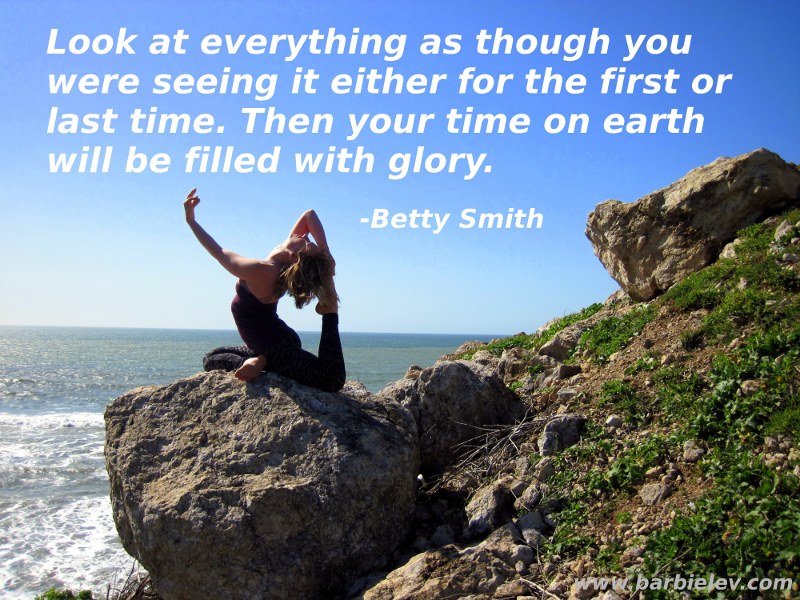
Look at everything as though you were seeing it either for the first or last time. Then your time on earth will be filled with glory. -Betty Smith

Look at everything as though you were seeing it either for the first or last time. Then your time on earth will be filled with glory. -Betty Smith

Look at everything as though you were seeing it either for the first or last time. Then your time on earth will be filled with glory. -Betty Smith

I was practicing with Jason Bowman a couple weeks ago. We did a sun salutation toward the end of class, and he cued as to practice it as if it were the last sun salutation we would ever practice. What a mindful, sensual, vital sun salutation it turned out to be! Try it for yourself.

What do the Yoga Sutras say about asana?

Q: What do the Yoga Sutras say about asana (yoga poses)?

A: According to Putanjali’s Yoga Sutras, the highest stage of enlightenment is reached in seven stages, and asana (the practice of yoga poses) is the third stage. Putanjali describes asana in three sutras:

The posture should be steady, comfortable and grounded in joy. (2.46)

When I was younger my unconscious philosophy was something like, “exercise should be recklessly fast, numbingly intense, and fueled by anger.” Exercise worked as a great coping mechanism for me. When I roller-bladed as fast as a could, I was so focused on not falling that there wasn’t room to worry about anything else. The aching in my muscles during a long run superseded aching in my heart. Exercise was something I could channel uncomfortable emotions into instead of letting them eat away at me. It was also empowering to see my body getting strong and healthy. It was a great band-aid for a while, but eventually it stopped working.

In my early twenties, I was experiencing a deeper heartbreak than I’d felt before, and no matter how vigorously and desperately I exercised, I couldn’t block it out. Then, in the midst of my suffering I discovered vinyasa yoga, and it was transformational. Through the metaphor of asana (poses), my teachers taught me to be still and notice my emotions, even if I wanted nothing more than to resist them and block them out—steadiness. They taught me that whatever was going on in my head, it was okay to be feeling was I was feeling—comfortableness. Through time and practice, I learned that my worth was defined by more than getting having a boyfriend, getting into a challenging yoga pose, or even being strong and healthy; I found out I was more than all of those labels—joy.

Posture is mastered by relaxation of effort and meditation on the unlimited. (2.47)

I tell my students that practicing asana is practicing for life. If we are able to relax our gripping, gritting, or gnashing and maintain a meditative state during a challenging pose, we are more likely to connect to that mindfulness when someone cuts us off in traffic or when our hearts get broken. In San Francisco, I teach an intermediate vinyasa class in which we practice challenging postures that Putanjali (author of the Yoga Sutras), probably wouldn’t have dreamed recommending for meditation. I constantly remind students that it’s not about the pose itself; the pose is just a construct to test your ability to relax and be mindful. In this respect, sometimes the more advanced variation of a pose is the one that challenges your strength and flexibility; sometimes it’s the one that’s physically easier, but challenges you to let go of our ego.

When posture is mastered there is a cessation of disturbances caused by dualities. (2.48)

Our minds operate by identifying opposites. It’s built into our language and logic. We understand light because we can contrast it a lack of light (dark). We understand ourselves as entities different from our environment, different from others. Sometimes we even dissociate our own body, mind, and spirit. These aren’t bad things, we need them to survive. But, they create an illusion of separation which can be a source of deep suffering.

I’ve already mentioned that through my personal asana practice lines between things I thought were separate began to blur: as I learned to practice with physical grace, I began to cope with my emotions more gracefully too. As I relaxed in the face of intensity on the mat, I was more able to handle stress and conflict off the mat. As my practice of mindfulness developed, I began to notice my profound effect on my environment, and my environment’s fundamental effect on me. The labels that used to define me and set me apart from others started to drop off. I began to think that maybe my sense of self was more of a pragmatic, survival-based construct that a metaphysical (real) one. As the edges of my identity began to dissipate, I considered that maybe there is something that has no opposite. Something that is everything. Something unlimited that connects us all; that is us all.
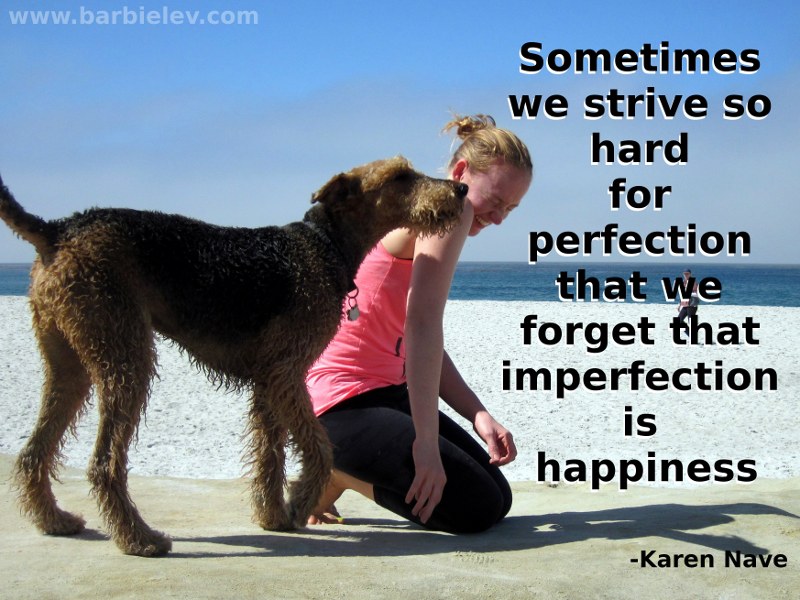
Sometimes we strive so hard for perfection that we forget that imperfection is happiness. – Karen Nave

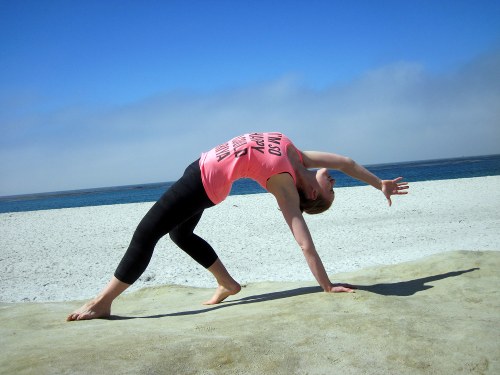
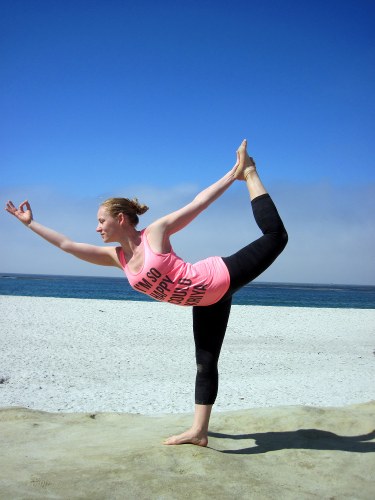
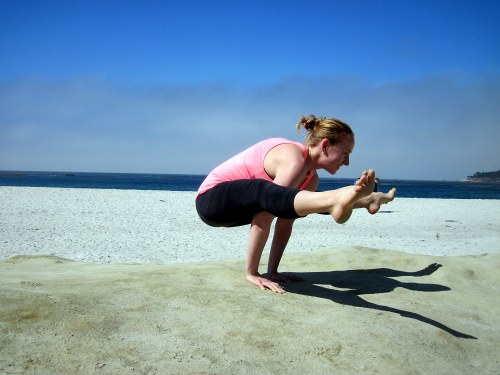
On a lovely weekend getaway to the peaceful ocean-side Carmel, California, my personal photographer (i.e. my husband, Richard) was snapping some shots of me doing some poses on the rocks along the beach. There must have been a airedale terrier meetup group at the beach that day, because there were fifteen or twenty of them nearby playing with each other, digging up sand, and retrieving balls from the water. Being in front of a camera brings out my inner perfectionist as I wrack my sensations to find my alignment and relax my face into a photogenic hint-of-a-smile. Just as I’d found one of my picture-perfect positions, one of the terriers jumped up onto the rocks to interrupt my posing and give me a moment of real yoga:

Sometimes we strive so hard for perfection that we forget that imperfection is happiness. - Karen Nave

Sometimes we strive so hard for perfection that we forget that imperfection is happiness. – Karen Nave

This focus on perfecting the physical aspects of the poses can also take over our practice on the mat. But the real yoga is not the shape the body takes, or the precise alignment, or the even serene facial expression. The yoga is the sukkha, the joy, the svadyaya, the self-study, the dharana and dhyana, the concentration and meditation. None of these come from a focus perfection—they come from cultivating acceptance. They come from a willingness to be who you are, where you are, what you are. Don’t get so caught up practicing the poses that you forget to practice the yoga.