High Lunge Twist and Bend

I recently attended a yoga class in which the instructor had us flow through this twisted backbend variation on high lunge, and I just loved it! Start in high lunge with the left leg forward and right leg back, making sure the left knee is right above the ankle pointed toward the second toe of the foot. Keep the back leg long without locking the knee, and press back through the back heal. Breathe.
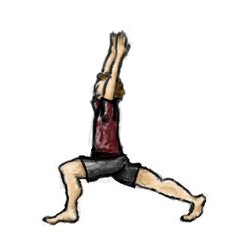
High Lunge

High Lunge

If this next bit feels a little awkward, you’re probably doing it right. Keep your base strong and on an exhale, lower the arms to shoulder height, extending the right arm forward and left arm back, thumbs up toward the ceiling. Twist the chest toward the left, and turn the gaze toward the back hand, if that’s available to you. Keep contracting the obliques (the side abdominal muscles) and resist the urge to lean forward. Breathe.
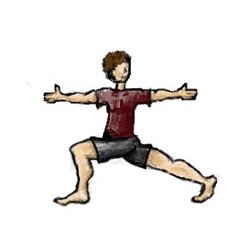
Upright Revolved High Lunge

Upright Revolved High Lunge

Contract the abdominals, and on an exhale, lower the left hand down to the back thigh and turn the right palm skyward. Inhale, extend the hand upwards so that the palm of the hand faces the back of the room. As you exhale, begin to back bend to your degree. Keep breathing.
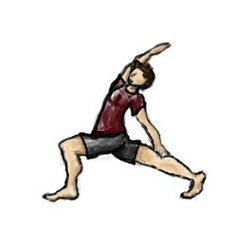
Reversed Twisted High Lunge

Reversed Twisted High Lunge

To get to the same sequence on the other side from here, inhale out of the backbend, exhale to windmill the hands all the way down to the floor, and cycle through a two- or one-legged vinyasa. From downward facing dog, step the right foot forward and inhale the arms up into high lunge.
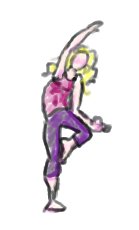

Tree Side Bend

I’ve been putting off posting lately because I haven’t had a chance to get photos of the poses and sequences I’ve been picking up. However, I recently got a tablet, so no more excuses! If I can’t arrange time for a photoshoot with my photographer (aka my husband), then hopefully my drawings will get the message across.

Today’s pose is pretty simple to explain, but it’s a really interesting variation to be in. It’s kind of like tree pose, but in the spirit of summer, it’s reminiscent of the windblown trees often seen by the beach. Begin in tree pose with the left leg as your root and the right leg pressing into the inner ankle, inner calf, or inner thigh (avoid the knee). As you inhale, send the arms straight up above the head, palms facing toward one another. As you exhale, lower the left hand down to the top of the left thigh, palm up. Take an inhale here, and then as you exhale come into a side bend toward your left, bending into the left elbow if it’s available to you.

Tree Side Bend

Exhale the back of the hand down to the thigh. Take an inhale, and then as you exhale, side bend.

To exit, inhale back to a neutral tree and gently release on an exhale. Make sure to balance it out on the other side.

Silence

My meditation practice has been waning a bit lately, but this morning I was reminded of the value of taking time to shut up and listen by this post on Elephant Journal. It brought to mind a song I wrote in french when I was seventeen that describes the value of silence. Funny how easy it is to forget moment of clarity one has in the past. Here is a translation (I promise it rhymes in French!):

Calm, serenity, peace, tranquility, pause, patience, simplicity, silence.

A hundred million prayers, a hundred million pleas,
She cried out day and night without result.
Some nights she screamed, some nights she cried,
But it was on a peaceful night when she finally understood:
If one wants a response, one must wait in silence.

It’s peace in the night,
It’s a moment without noise,
A star in the skies,
It’s the voice of God.

Without understanding, he said “I love you.”
He was smooth talker, but they left him anyway.
But she took his words away, she stopped his thoughts.
He never wanted to let go of her hand.
With a word, she explained to him:
There isn’t language that can describe this emotion.

It’s the end of a war,
It’s love without fear,
It’s the union of two,
It’s the voice of God.

If one wants to see, one must look.
If one wants to hear, one must listen.

It’s a tear on a someone’s cheek,
It’s a smile without a word,
It’s the joy in someone’s eyes,
It’s the voice of God.

Calm, serenity, peace, tranquility, pause, patience, simplicity, silence.

Half Twist Switches

Switching from half twist (ardha matsyendrasana) on one side to half twist on the other side can be kind of cumbersome, so here are two graceful transitions for switching sides.

The first option is to do a pivot-turn to get to the other side. It’s easier than it looks! Once you’ve completed the twist on the first side, look in the other direction to guide your turn. Keep the feet exactly where they are, and turn the body. Allow the feet to pivot until you come all the way around to the front again. Sit your buttocks down between your heals for half twist on the other side.

Switcheroo

Keep the feet exactly where they are, and pivot around to the other side. (click for larger image)

The first time I saw this next transition, I thought it was totally ridiculous, but it’s actually kind of fun. After you complete the twist on the first side, bring the hands in front of you on the mat, and come into a tripod headstand with the legs crossed. In tripod headstand switch the cross of the legs. When you come back down, you’ll be ready for half twist on the other side.

Tripod Headstand Transition

Come into tripod headstand with the legs crossed, and switch the cross of the legs. (click for larger image)

Okay, so maybe that one wont be immediately graceful, but it’s certainly an interesting variation.

The Mind is a Tool

In a recorded satsang by Adyashanti entitled Immesurable Value, someone asked him what to do with a busy mind. Adyashanti responded:

Take it to work with you. That’s what minds are for. They get things done … They’re like tools. They’re like a hammer. You take it out of the box, you pound nails, and before you know it you’ve got a nice room like this. A mind is a tool. But we’re so insane. We look at a tool, and we go, “who am I?” You don’t go home and ask your hammer, “who am I?” You know what would be worse is if it actually talked back to you… like the mind does… ‘Cause then you’d listen to it for a while… The mind is a beautiful tool. It does some wonderful things. Very powerful tool. But the tool’s not the thing to ask, “what’s reality?” You ask reality “what’s reality?” It’s like a painting. You don’t ask the painting about the painter. You don’t ask the mind about where the mind arises from.

At first this seemed like it had to be a bad analogy, but the more I considered it, the more it reminded me similar ideas that came up in the philosophy of mind classes I took in university. Philosophers can get their heads around most consciousness related problems, but one that persists is the question of how and why subjective experience (consciousness) arises from the physical brain (coined the Hard Problem of Consciousness). No one has yet come up with a theory that satisfactorily explains this phenomenon. In fact, there are philosophers who agree with Adyashanti that the human mind may not have the cognitive ability to understand the full nature of reality. Colin McGinn argues that although we can observe consciousness through introspection, and we can observe the physical brain, and we may even be able to draw some correlations between what’s happening in consciousness and what’s happening in the brain, we have no way of clearly observing how consciousness mysteriously arises from the brain. Just as one could not expect a mouse to attain many of the sophisticated cognitive capacities of a human, humans may not have the cognitive capacity required to understand how or why consciousness arises.  This train of reasoning leads to the same conclusion as Adyashanti’s: you shouldn’t bother to ask the mind about where it arises from.

So, how do you find out “who am I?”? I will leave Adyashanti’s suggestion to directly ask reality, “what’s reality?” to your own interpretation and meditation.

(A brief, accessible summary of Colin McGinn’s argument for those interested).
