One-Legged Vinyasa

To add a challenge to your vinyasa, you can try this single leg variation. Feel free to switch to a two-legged vinyasa at any point during this sequence–some of the transitions are harder to do one-legged than others. Begin in a plank with one leg lifted. If you’re incorporating this into a larger flow, one-legged plank can follow naturally from downward facing dog with one leg lifted or from side plank with the top leg lifted.
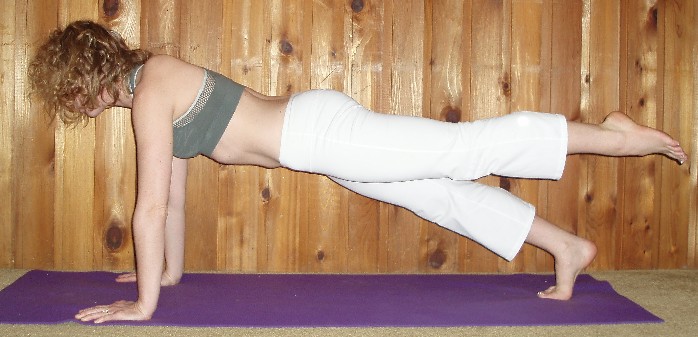
One-Legged Plank

Begin in plank with one leg lifted.

Keeping the leg lifted, as you exhale lower slowly to chuttarunga. Keep the abdominals contracted, elbows close to the body, and shoulder blades sliding down toward the hips. In chuttarunga, the torso should not sink below the level of the upper arms as this can put the shoulders into a bad position.
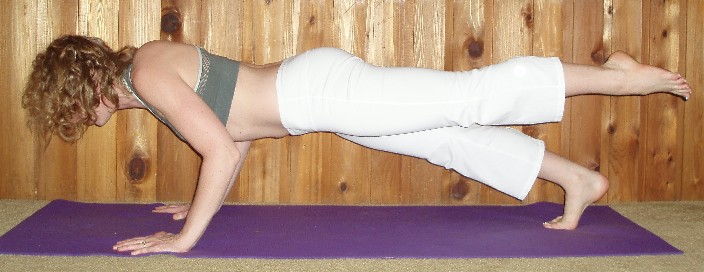
Lower to One-Legged Chuttarunga

Exhale, lower to one-legged chuttarunga.
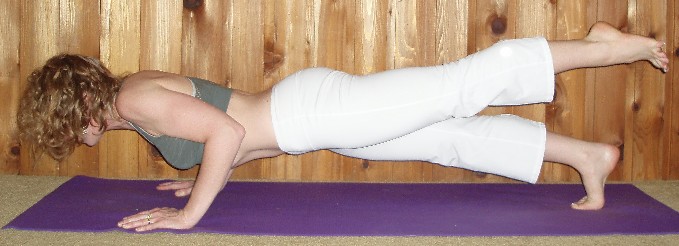
One-Legged Chuttarguna

One-legged chuttarunga.

Contract the abdominals to protect the low back, and as you inhale pull forward into upward facing dog. If you can, keep the leg lifted. Notice that you have to roll over the toe so that the top of the foot is on the floor. In upward facing dog the quads (muscle in the front of the thigh) are contracted so that the hips are lifted. Squeeze the shoulder blades back and together, and slide them down the spine.
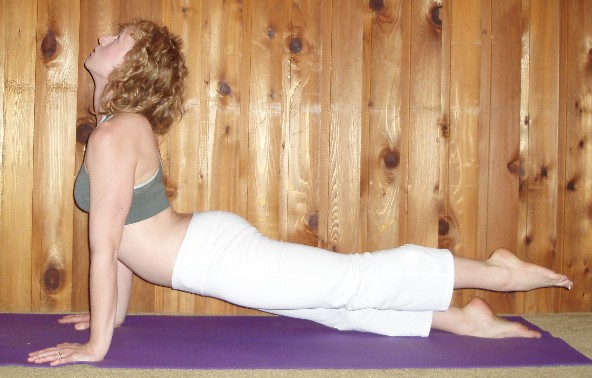
One-Legged Upward Facing Dog

Inhale, lift to one-legged upward facing dog.

This next part is the hardest. Rolling back over your toe requires you to use your tibialis anterior muscle in the front of your lower leg, and this muscle is often quite weak. You can lower the lifted leg here if you need to. Here we go: contract the abdominals (you’ll need them!) and as you exhale press back to a downward facing dog with the leg lifted.
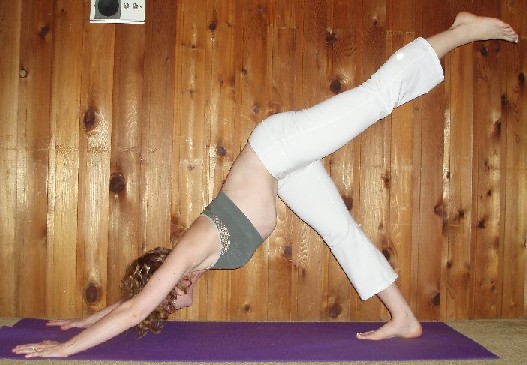
One-Legged Downward Facing Dog

Exhale, press to one-legged downward facing dog.

From here you can go all sorts of places: pigeon? High lunge? A warrior? Handstand? That’s up to you!
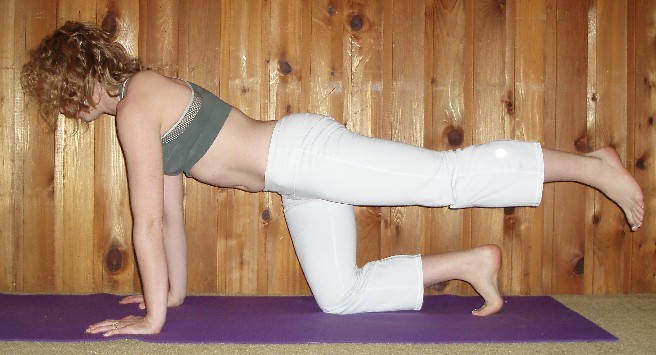
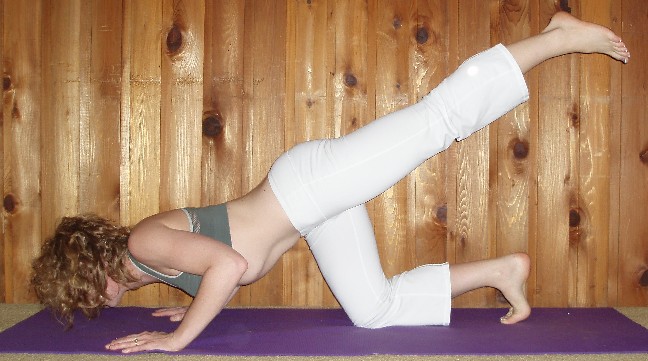
Variation on Dancing Cat

Here’s another one I came across in San Francisco. I’ve seen dancing cat before (from hands and knees, extend one arm and the opposite leg on an inhale, then bring elbow to knee on an exhale), but this is a fun variation.

Start on hands and knees with one leg extended straight out behind. Holding your leg in this position works the low back muscles, hamstrings, and glutes isometrically (with the muscles staying at one length)

Leg extended

From hands and knees, extend the leg out behind.

As you exhale, bend the elbows, keeping them in close to the body. Bring the chest down toward the floor. The same leg stays lifted throughout. Keeping elbows in close to the body puts the focus on the tricep muscles instead of chest muscles. It also keeps the shoulders rolling forward.

Elbows bent.

Bend the elbows.

As you inhale, straighten the elbows, lifting the chest away from the floor. The same leg is still lifted.

Leg extended

Straighten the elbows again.

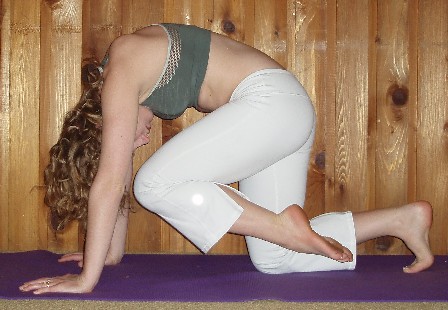
Now, as you exhale, bring the knee in toward the nose and nose in toward the knee. This motion works the abdominal muscles, especially if you really round through the spine: think about tucking the chin and tail bone under and drawing the belly button back toward the spine.

Knee to nose, nose to knee.

Bring the knee in toward the nose and the nose in toward the knee.

As you inhale, extend back to the starting position, re-engaging the low back muscles, glutes, and hamstrings. Repeat the flow as many times as you like on this side, and then balance it out on the other side.

Leg extended

Return to the starting position. Repeat the flow.

Supported Bridge

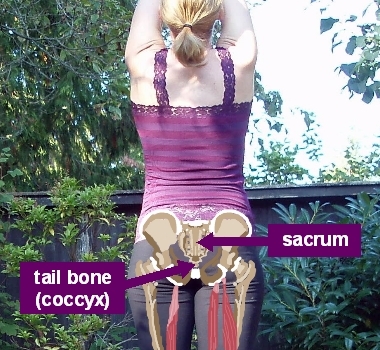
I picked up this variation on setu bandhasana in a restorative yoga class I attended in San Francisco a while back. Before you get started, you have to figure out where your sacrum is. Your sacrum is the part of your spine that acts as the posterior (back) wall of your pelvis. The spine is made up of bones called vertebrae that are stacked one on top of the other, but in the sacrum these bones become fused. So, if you feel down your spine in the low back, you’ll feel the bump of each vertebra, but when you get to the sacrum (in the back of the pelvis), the bumps will become much less pronounced. The very end of the spine, just inferior to (below) the sacrum is the coccyx, or tail bone.

The sacrum is above the tail bone.

The sacrum acts as the back wall of the pelvis. It is above the tail bone.

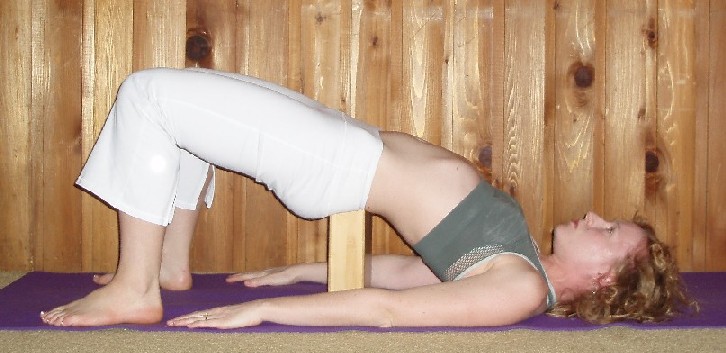
The instructions for this posture are pretty simple. Make your way into setu bandhasana (bridge pose), and then slide a block under the sacrum. Make sure that the block isn’t underneath the low back or tail bone, these areas are not as stable as the sacrum. Remember that yoga blocks can have three different heights, depending on which side you put them on, to accommodate different levels of flexibility. Make sure you put the block in the best orientation for your body. The low back is susceptible to injury, so you do have to be careful here. Avoid getting in the habit of sustaining pain in the low back. Even if you don’t get injured during your yoga practice itself, you will carry this habit into the rest of your life where there are less controlled situations, and the chance for injury is much greater.

Supported bridge

Supported bridge.

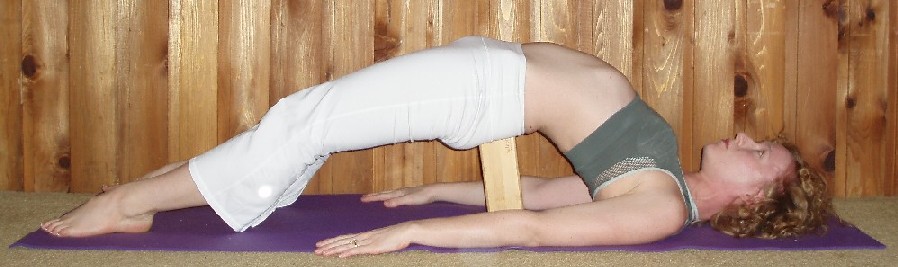
If you feel comfortable in this posture there is another variation you can take: lengthen out the legs, placing the feet closer to the end of your mat. You may need to readjust the block to make it more comfortable. This deepens the bend in the low back, so make sure you return to the previous variation or change the orientation of the block if you feel any discomfort. If you want to add a little more length, extend the arms in the opposite direction, reaching out past the top of your mat.

Legs extended

Supported bridge with legs extended.

This pose improves flexibility in the spine, and stretches the hip flexors (muscles in the front of the hip) and abdominals (stomach muscles).

Wild Thang

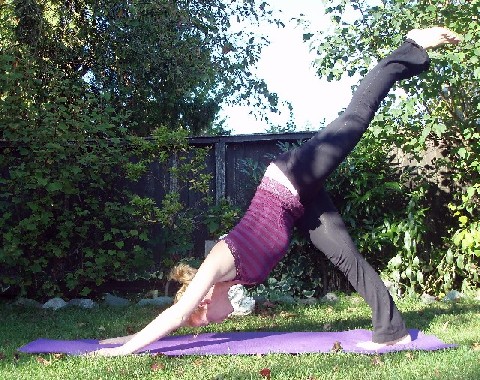
Here’s an interesting hip-opening sequence you can take from downward facing dog. First, as you inhale, lift one of the legs upwards. This position builds strength in the lower back, glute (butt), and hamstring (back of the thigh) muscles. For some of you, it will be most appropriate for you to stay here to develop your strength and flexibility.

Three-legged down dog

Three-legged downward facing dog.

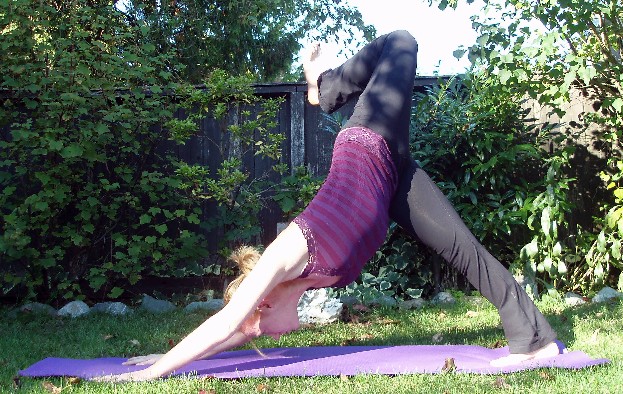
If you can comfortably raise your leg above above the height of the hips, you can turn this into a hip-opener: on your next exhale, bend into the knee and let the heel relax across to the opposite side of the body. You should feel a stretch in the hip flexors (muscles in the front of the hip) of the lifted leg. Make sure you keep the abdominals contracted to protect the low back.  This is a really nice hip opener if you have the flexibility to get here.

Dog dog hip opener

Bend into the knee and let the heel relax across to the opposite side of the body.

Some points of debate:

  • some teachers say to keep the foot flexed, rather than just relaxing it. I’m not sure exactly what the justification is, but does seem to add integrity to the posture.
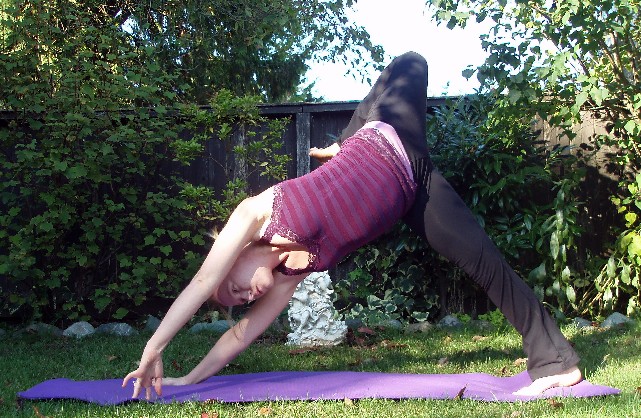
  • As shown in the image above, I suggest you keep your chest squared to the floor (as much as possible), just like you would in downward facing dog; however, some teachers suggest you look out under the armpit (the one of the same side as the leg you’re lifting). Letting your torso twist in the direction allows you to get your leg farther across the body, which will allow gravity to do a little more work for you, and pull the leg into a deeper hip flexor stretch. The problem with this variation is it’s very easy to compromise the low back. If you do it this way, make sure you’re keeping the abdominals contracted and monitoring the low back.

If you know that you are comfortable with back bends, you can “flip the dog” into wild thing. But seriously, you have to be sure you can handle it, because there’s a point of no return in the transition–after that point you’ll continue all the way into wild thing, whether your body likes it or not. Staying in the previous posture is a really nice hip opener for those of you without an advanced back bending practice.

I don’t think there’s a better way to put this in words than by telling you to contract the abdominals, keep it under control, and “flip the dog” as you exhale.

Flip the dog.

Beginning to flip the dog...

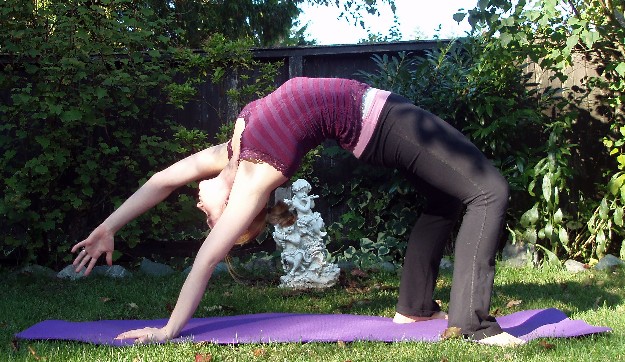
The foot of the bottom leg rotates so the toes point toward the back of the mat. As the belly turns skyward, the foot of the top leg continues down to the mat. The soles of the feet end up flat on the mat. The hand that lifts (the one on the same side as the lifted leg) is going to stay lifted and extend toward the front of the mat. You are now in wild thing. Does everything feel… groovy?

Wild Thing

...ending up in wild thing.

In wild thing, make sure you keep the low back muscles contracted to support your pose. Keep the abdominals contracted to control the arch of the back. To explore your flexibility, think about contracting the quads (the muscles in the front of the thighs). This will begin to straighten the knees and raise the hips up higher.

To get out of wild thing, just follow the steps in reverse. Contract the abdominals and inhale as you flip back to downward facing dog.

Refining Your Hamstring Stretches

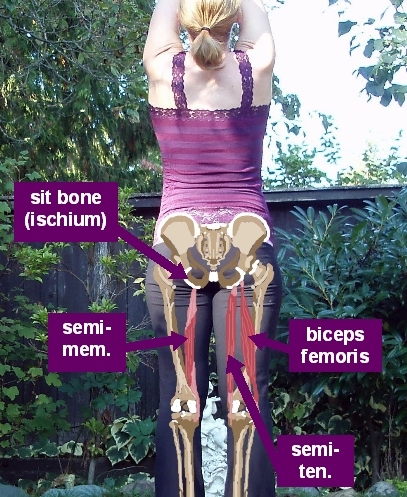
Okay, bear with me for a bit of anatomy here: although we often think of the hamstrings as one muscle, it is actually group of three muscles: the biceps femoris, the semimembranosus, and the semitendinosus. All these muscles have slightly different orientations.

Hamstrings

The Hamstrings start at the sit bones, and are made up of three muscles.

In general, all the hamstring muscles start at the sit bones and end up attaching into the lower leg bones. So, to stretch them, you have to get the sit bones and lower leg bones as far away from each other as possible. Some ways to do this is are straightening the leg at the knee or bringing the thigh in toward the chest, which draws the lower bones farther away from the sit bones. Another way to do it is to tilt the sit bones away from the lower leg bones–this happens naturally when you hinge the torso forward toward the thigh.

Based on this info about the anatomy of the hamstrings, here are a couple tips for refining your hamstring stretches:

1. For a deeper stretch, actively tilt the sit bones away from the lower leg bones.

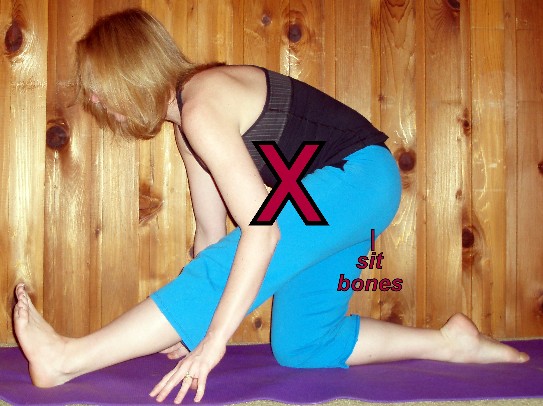
In some poses, such as half splits, you have quite a bit of control of how you tilt the pelvis. If you keep the sit bones tucked under, you are taking some stretch out of the hamstring muscles and sending it into the low back muscles.

Sit bones tucked under

Half splits with sit bones tucked under.

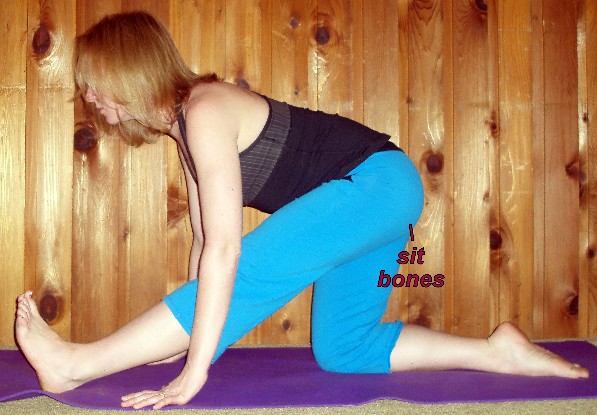
To maximize the hamstring stretch, think about contracting your low back muscles to tilt the sit bones toward the back of your mat.

Sit bones tilted back

Half splits with sit bones tilted back.

This tip can be applied to downward facing dog and standing forward bend as well. Even in a seated forward fold, you can “walk” the sit bones back.

2. You don’t have to straighten at the knee to get a good hamstring stretch.

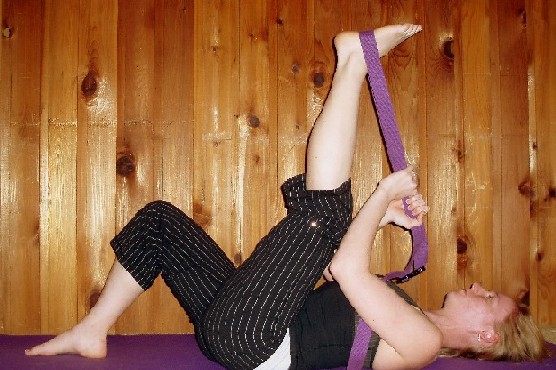
The hamstrings are one of the few muscle groups in the body that cross two joints: the hip and the knee. For those of you who are sensitive behind the knee, you’ll be happy to know that you don’t necessarily have to straighten the knee to get a good hamstring stretch–work from the hip joint instead. For example, if you’re doing a hamstring stretch laying on your back, you can focus more on bringing the thigh in toward the chest than straightening the knee. Find a balance between these two actions: you should feel a stretch in the back of thigh without feeling discomfort behind the knee.

Knee bent

Hamstring stretch with bent knee.

In this pose, it’s easy to let the sit bones and tail bone curl up upwards, which can take away from your stretch. For a deeper stretch, lengthen the bottom leg out along the mat, so your legs make an ‘L’ shape from the side.

3. Rotate the legs to stretch different hamstring muscles.

The hamstring muscles are all stretched best at different leg orientations.  The biceps femoris is stretched best when the thighs are rotated medially (think toes turned in toward the midline of the body). The semimembranosus and semitendinosus are stretched best with thighs rotated laterally (think toes turned out away from the midline).

Toes turned in.

Having toes turned in stretches the biceps femoris.

Next time you do a standing forward fold, experiment with toes turned in and toes turned out and find out where you hold your tension.