Some Love for the Lower Legs

I used to come out of Bikram yoga classes with such tight calves. Balancing requires the lower leg muscles to work together to stabilize the ankle, and the standing series would completely exhaust my already tight muscles. I asked the teacher why there were no poses in Bikram yoga to stretched the calves, and he said there actually were. He gave head to knee pose as an example, which is a seated pose in which you fold forward over a lengthened leg. The calf stretch comes from using the hands on the ball of the foot to lift the heel off the floor and pull the toes back toward the face. I think calling head to knee pose a calf stretch is a misnomer, considering only the the most flexible students could ever reach the point where the pose actually stretches the calves. Similarly, many yoga teachers use downward facing dog as a calf stretch when many students’ other muscles are so tight that they can’t get enough downward force through the heal to feel anything in the calves. Tight lower leg muscles can cause shin splints, knee problems, and foot problems, so it is important that achievable lower leg stretches are incorporated into yoga classes.

Gastrocneumius stretches. The gastroc is the big meaty muscle in the calf, and it is stretched when the leg is lengthened and the foot is flexed. A gastroc stretch that doesn’t require too much flexibility in other muscles can be done starting from hands and knees. From there, extend one leg out behind, tuck the toes under on the floor, and extend actively out through the heel. You will feel the stretch in the calf.
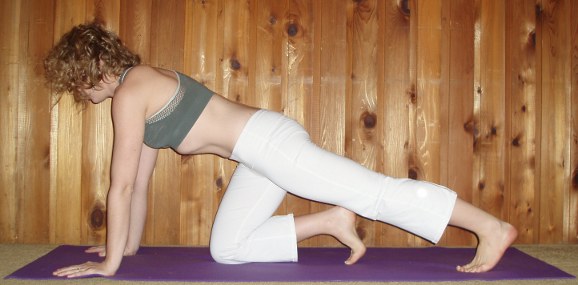
Hands-and-knees gastroc stretch

Press actively back through the heel.

If you’re more flexible, you can go into a downward dog variation. From the previous position, press into the hands to lift the front knee off the mat. Lift the sit bones up without losing engagement in the core, and push down through the back heel. You can keep your front foot where it is for support or tuck it behind the ankle of the leg your stretching, increasing the stretch even more.
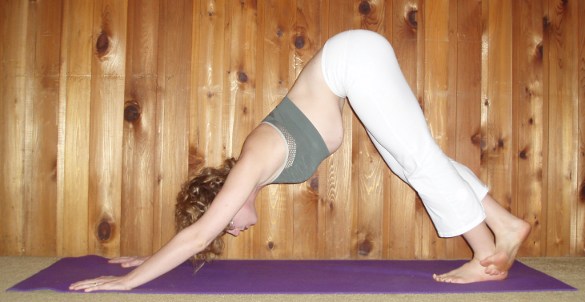
Down dog gastroc stretch

Press chest and hips back, and the heel downwards.

Soleus stretch. The soleus is another muscle in the back of your lower leg that runs underneath the gastroc. When you stretch it, you often feel it in the Achilles tendon area between the meaty part of your calf and your heel. It is stretched when the knee is bent and the foot is flexed. From the hand-and-knees position above bend into the back knee as you continue to press back through the heel, and you’ll feel the stretch move into you soleus.
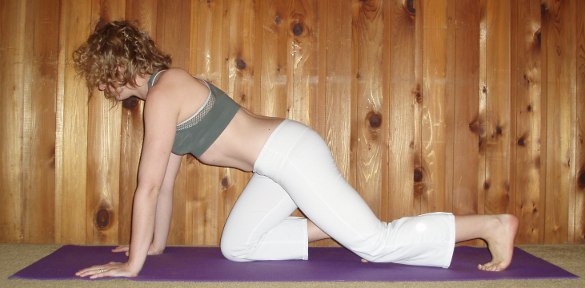
Hands-and-knees soleus stretch

Keep pressing back through the heel as you bend into the knee.

Similarly, from the downward facing dog-like position, bend into the knee of the leg your stretching to move the stretch into the soleus.
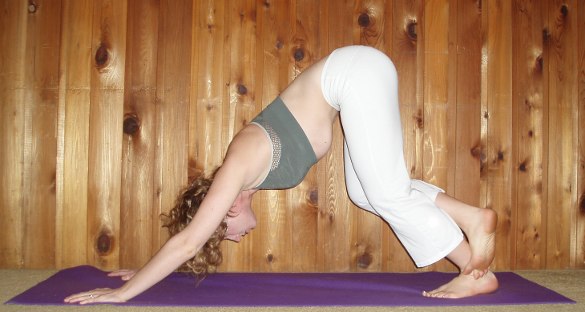
Down dog soleus stretch.

Keep pressing the hips back and the heel downwards as you bend into the knee.

Toe-Flexors Stretch. Many of the muscles that control your toes are in your lower legs. The stretches above will stretch the toe-flexing muscles, but we can target them even more by bending the toes back. A friend of mine coaches swimming, and her swimmers always dread when she tells them it’s “social time” during their stretching session, because although that means they’re allowed to chat, it also means they have to sit in the following position for a couple minutes:

"Social Time"

"Social Time"

To get into this position, sit on the heels and tuck all ten toes under. If this bothers your knees, place a blanket or block in between your buttocks and heels so your knees don’t have to bend so deeply. This position feels like nothing at first, but give it a minute or two and the intensity will set in. You may feel the intensity in the soles of your feet as well as in your calves.

Tibialis Anterior and Toe Extensor Stretches. The often neglected tibialis anterior is located in the front of the lower leg, along with your toe-extending muscles. To stretch them, you have to point the foot and curl the toes. From a downward facing dog position, turn one foot over so that the top of the foot is pressing down into the floor instead of the sole. The legs can be slightly bent if that is more comfortable. Press into the hands to lift the hips up and back, increasing the stretch in the front of the lower leg. You can keep only one foot flipped, or you can turn both feet over to stretch both legs as the same time.

Tibialis anterior stretch.

Turn the feet over so that the tops of the feet are on the floor.

Hold each position for at least 20 to 30 seconds to allow to muscles to relax into the stretches.

What is a Spiritual Teacher?

I just read a great article about how to conduct yourself as a yoga teacher: Five Keys to Great Yoga Sequencing by Derek Beres. This paragraph made me laugh out loud, because I could really identify with it:

Ground yourself. I am not what you’d call a ‘spiritual’ teacher. In fact, I have no idea what that term really means. Spirituality is usually defined as believing that another way of existing in the world is possible but that you’re not living it. That’s a neurosis, not a mark of divinity. It’s fine to acknowledge and work through conflicts, but don’t celebrate them. Go to the source and confront it. I’ve been in a number of classes where the instructor spends half the time talking about very abstract principles of future lives, gods and spirits and souls and weird translations of karma, and yet cannot remember the sequence that they’re teaching. The right side of the flow ends up completely different than the left. Offering students unbalanced asana sequences is not balanced out by taking them out of the room. Ground the flow first; then if you need to fly off, go for it. But you won’t get any height if your feet don’t begin on the ground.

According to Shakti Mhi, who taught my Level 1 Yoga Teacher Training, spirituality is to see beyond the concepts that form our sense of identity, and get in touch with our true nature. By this definition, I would say any yoga teacher who encourages mindfulness is a spiritual teacher, even if it’s as simple as saying “focus on your breath.” “Future lives, gods and spirits and souls and weird translations of karma” can help guide many people toward spirituality, but they can also be counterproductive. As in the example Derek Beres gives, yoga teachers can get so caught up talking about spirituality that they forget to teach spiritually and mindfully. It’s hard to be an effective spiritual teacher if you’re not leading by example. As yoga teachers our job is to meet people where they are, and, from there, gently lead them on a journey towards greater strength, flexibility, or spirituality, depending on what they’re open to. If you rush people into a journey on which they’re not ready to embark, they’ll leave thinking something like, “Yoga is too hard for me” or “That class was so boring” or “I signed up for a yoga class, not a seance.” You have to be mindful of your crowd. You have to accept them as they are instead of perceiving them as you’d like them to be. You have to make it worth their while to put aside their yoga DVD and come into a space where their teacher can see them, hear them, and feel them. Of course, you can’t please everyone and different classes have different target audiences, but, as Derek Beres says, “dialogues are always better than monologues.”

Advanced Yoga Teacher Training Day 7: Transformation

The seven-day advanced yoga teacher training course had consisted of a gradual layering. On the first day, we stripped away a lot of the intricacy of being a yoga teacher, and focused on self-awareness and relaxation. As the week progressed, we added more and more layers to build us back up into full-fledged  yoga teachers. The last day was a chance to get a bit more practice and feedback on our teaching, reflect on our strengths, and foster compassion for our weaknesses.

We spent about half the course focusing on personal development, which may seem like overkill, but I learned a long time ago that you can’t give from empty pockets. Dina quoted Sharon Salzberg, saying “the point of practice is to develop a mind so open that it can experience great pleasure and great pain with spaciousness, with compassion, with awareness, with energy.” That’s a pretty tall order, and a yoga teacher has to be a rock in order to hold a safe space that supports this development.

On the last day, we discussed a focus on present moment awareness can actually help you set goals for the future (these things have always seemed to be a bit at odds for me). If you begin with awareness of the present moment and compassionate acceptance of what is, you gain self-awareness and begin to see reality more clearly. Instead of getting caught up dwelling on the past, obsessing about the future, labelling, judging, etc., your energy goes towards illuminating your path.

Dina concluded by giving us a guideline for personal development. She pointed out that, as yoga teachers, we are at our best when we are teaching yoga. Once we leave the studio, we are not always so mindful and put-together. She suggested we strive to be the person we are as a yoga teacher in the rest of life as well. One of my classmates summed it up by spoofing a popular bumper sticker, “Lord, help me to be the person my yoga students think I am.”

This post is part of a series describing my experience with the first module of my advanced yoga teacher training (RYT500).
Advanced Yoga Teacher Training
Day 1: Resistance
Day 2: Acceptance
Day 3: Breath
Day 4: Emotions
Day 5: Energy
Day 6: Asana
Day 7: Transformation

Advanced Yoga Teacher Training Day 6: Asana

On day six, we went over some advanced postures, including wheel, feathered peacock, and handstand.

After going over energetic lines and spirals the previous day, the instructions for these postures were so much more intuitive than they were before. In wheel, just like in bridge or camel, you draw your chest bone and tail bone in opposite directions, cup the shoulder blades under the back, and internally spiralling the thighs. In handstand, you root and extend in opposite directions through the hands and feet, internally rotating the thighs, just like in mountain pose with the arms raised. You externally spiral the arms (think armpits toward the face; it’s counterintuitive when your arms are in this position), draw the shoulder blades toward the hips, and draw the front rib cage toward the navel, just like in downward facing dog. We went over some specific progressions to build up to these advanced postures, but I’ll put a push pin in those and save them for future posts.

This post is part of a series describing my experience with the first module of my advanced yoga teacher training (RYT500).
Advanced Yoga Teacher Training
Day 1: Resistance
Day 2: Acceptance
Day 3: Breath
Day 4: Emotions
Day 5: Energy
Day 6: Asana
Day 7: Transformation

Advanced Yoga Teacher Training Day 5: Energy

Day 5 was probably the most useful day for me as a teacher and practitioner. I’ve always been a little averse to teaching yoga in terms of energy. I think going over-the-top with chakras and prana can make classes less accessible to new students. Also, my background in science makes me a little wary of traditional knowledge. But, after this yoga teacher training, even I can’t deny that referring to energy flows is an incredibly effective way of guiding someone into proper alignment clearly and concisely. Being in proper energetic alignment totally changes the postures, easing tension, and making you feel like you can hold even the most challenging poses forever.

We started by observing each other doing poses, and tried to identify areas of tension. It was an interesting way to observe yoga poses. Often as yoga teachers we get caught up on making everyone adhere to an “alignment checklist” rather than tapping into how each individual is experiencing the posture, and trying to guide them into more ease.

Speaking in terms of energetic lines can help people find a sense of ease. Rising and rooting energetic lines are in opposition, so in yoga, you should feel as if you’re rising up through the crown of the head, sides of the rib cage, and the inseams of the leg as much as you’re rooting down through the feet, tailbone, font rib cage, and shoulder blades. I have a tendency to rise more than to root, so when I’m in standing postures, especially if my arms are lifted, I need to focus on contracting my quads to actively press down through my feet.

Balancing expanding and harnessing energy lines is also important. While expanding across the chest and upper back or reaching the arms out to the sides, you want to draw the arm bones back into the shoulder sockets. For me, focusing on balancing expansion and harnessing around the shoulders, chest, and upper back is the key to holding side plank pose.

I think inner and outer spirals are the hardest to get your head around, but they are key to finding a posture. Inner spirals correspond to internal rotation of the limb (the front side of the limb moves toward the midline of the body) and outer spirals correspond to external rotation of the limb (the front side of the limb moves away from the midline of the body). Just like with the other pairings, inner and outer spirals should be balanced. If the thigh is externally rotating, as in the front leg of warrior II, the lower leg and foot should be internally rotating. Between the internal and external rotation, weight should be even across the big toe and little toe sides of the foot. The external spiral shifts weight to the outer edge of the foot, whereas the internal spiral shifts weight the inner edge of the foot.

It takes some effort and focus to get into balanced energetic alignment, but the end result is a sense of ease in the posture. Dina characterizes it as, “subtle effort towards effortlessness.”

This post is part of a series describing my experience with the first module of my advanced yoga teacher training (RYT500).
Advanced Yoga Teacher Training
Day 1: Resistance
Day 2: Acceptance
Day 3: Breath
Day 4: Emotions
Day 5: Energy
Day 6: Asana
Day 7: Transformation