Put the Kibosh on Upper Back Tension

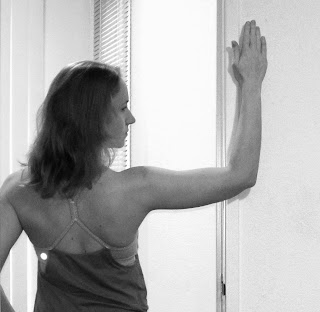
You may be surprised to know that tight chest muscles are often the culprit behind aching shoulder, upper back, and neck muscles. Writing e-mails, texting friends or driving to work, we spend most of the day in one position: seated with our shoulders slumped and our arms out front. With our body in this shape, our chest muscles are at their shortest, and over time they tighten to stay this way. In turn, when the chest muscles are shorter, the we tend to slouch even more—it’s a vicious cycle. In response, the muscles in the upper back, shoulders, and neck compensate, becoming tired, sore, tense, and overstretched. Read More on the Yoga Mayu blog>>
Office Chest Stretch

Office Chest Stretch

Visit my website for my Yoga Mayu schedule.

Full Bird of Paradise

Easy bird of paradise seems to come up relatively frequently in the classes I attend, but I don’t often see full bird of paradise, so I thought I’d offer it to you.

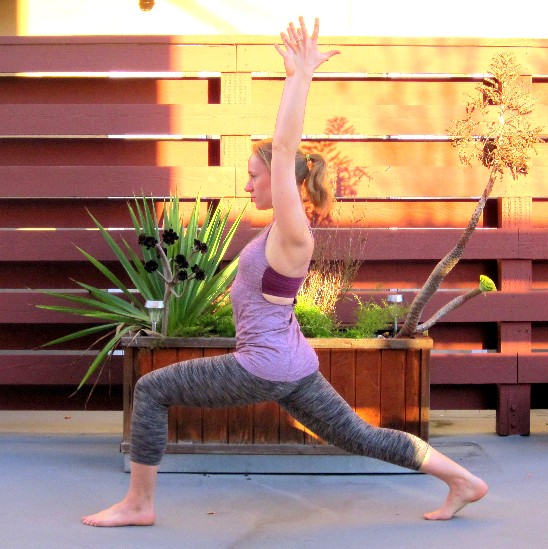
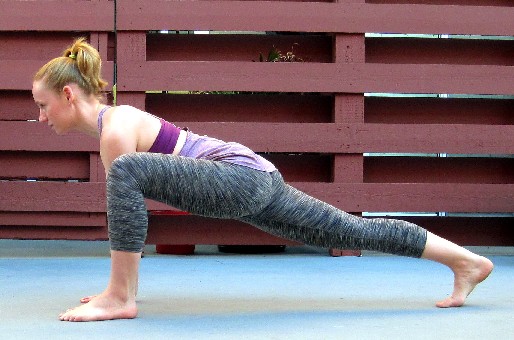
Begin in high lunge, with you left leg forward and right leg back. Make sure you left knee is right above the ankle, and the knee is pointed in the same direction as the toes. The back leg should be extended and strong, so press back through the right heel. As you lift up through the crown of the head, root the tail bone down, draw the front ribs toward the navel, and bring the shoulder blades down the back.

High Lunge

High Lunge

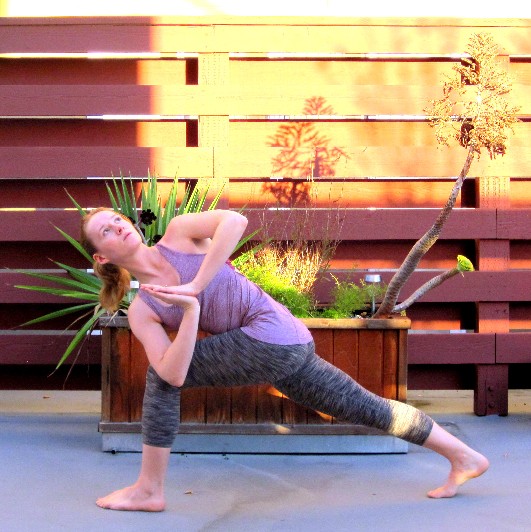
On you next exhale, come into revolved high lunge: twist to your left and bring the right elbow to the opposite side of the left knee. This may be as far as you go, and that’s okay!

Revolved Lunge

Revolved High Lunge

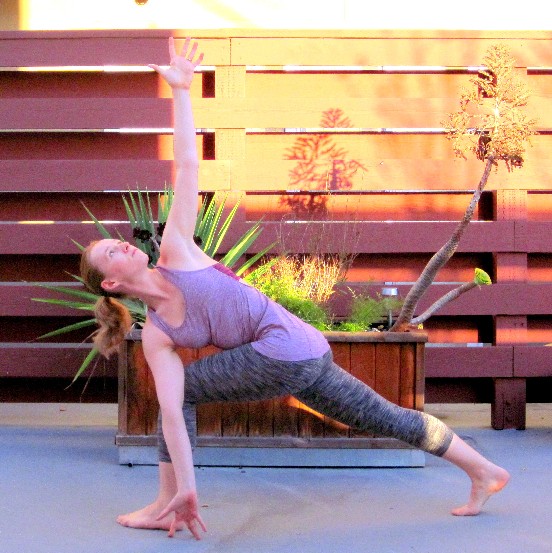
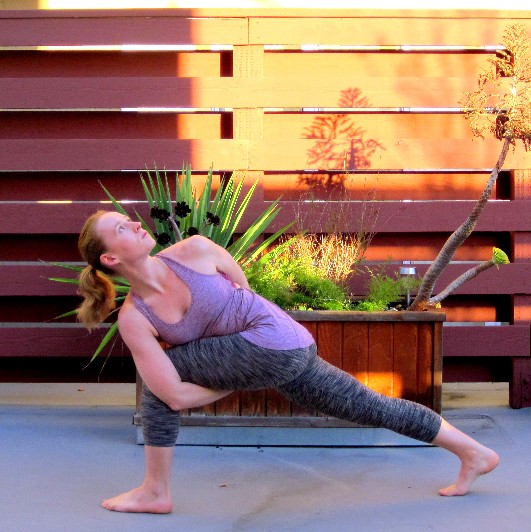
If it’s available to you, keep the right elbow outside the left knee and extend the right fingers down toward the floor, left finger tips skyward. Breathe.

Extended Revolved Lunge

Extended Revolved Lunge

From there, if you have the arm length and flexibility, you can bring the right arm under the left thigh and the left arm over the low back to bind your hands together underneath the body. You may use a strap to supplement.

Binded Revolved Lunge

Binded Revolved Lunge

Take a deep inhale, and then as you exhale, step the right foot to the front of your mat, under control, so that the feet are side by side. Maintain your bind and breath.

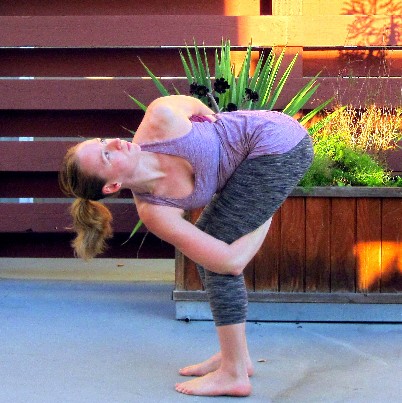
Revolved Forward Fold with a Bind

Revolved Forward Fold with a Bind

Root into your right foot, and on an inhale, slowly begin to lift the left foot off the mat, coming to standing upright. Allow the chest to twist the the left, and let the eyes follow or look out past the back of your mat.

Full Bird Preparation

Full Bird Preparation

If it’s available to you, straighten the left leg. Breathe.

Full Bird of Paradise

Full Bird of Paradise

To exit, rebend the left knee and gently lower the left foot back down to the floor. Release the bind and repeat the sequence on the other side.

Mindful Relationships: The Five Love Languages

In my last Mindful Relationships post, I considered the idea of holding your partner as the object of your meditation, constantly working to perceive them as they truly are and to serve them based on this accurate perception. Considering the people closest to us are often the ones we treat the worst, this is no small task! It takes quite a bit of self-study to recognize and catch yourself on your bad habits. I find it helpful to read books about success in relationships to help me identify my blind spots. Some are better than others and some are preachy, but from each book I’ve read, there has been a gem of knowledge I’ve been able to take away.

One of the first relationship books I read was The Five Love Languages by Gary Chapman. The gist of the book is that different people express and understand love in different ways, and that it is easy for love-miscommunications to occur when people do not understand one another’s “love language.” The love langauges Chapman identifies are:

1. Words of Affirmation. People who express love by offering words of encouragement, praise, and kindness speak this love language.

2. Gifts. People who tend to give gifts and other physical tokens to people they love probably speak this love language.

3. Acts of service. People who do things for others to show they care are communicating in this love language.

4. Quality time. People who express love by spending time to connect and communicate with their loved ones with them speak this love language.

5. Physical touch. People who express “I love you” through a hug, a shoulder squeeze, or by holding hands express themselves in this love language.

The purpose of laying out the love language is not to slot people into boxes. Few people  use exclusively one of these love languages; however, most of us express and understand some of them better than others. Problems may arise  in well-intentioned, loving relationships when one person expresses love in a way that the other does not understand. For example, I tend to shower my husband with praise and gratitude to express my love to him, but the intent of these words affirmation are almost completely lost on him. Words of Affirmation is not one of his love primary languages. Even with all that effort on my part, if I did not take the time to cuddle up to him while watching a movie, hold his hand while walking down the street, and give him a kiss and a hug before leaving for work, he would not feel adequately loved, because physical touch is one of his primary love langauges.

Failing to communicate to my husband in a love language he understands would not only be unsatisfying for him, it would also be exhausting for me! I would feel like no matter how much I did to show their him I loved him, it would never be enough. The key is to go back to really seeing, hearing, and feeling your partner. How do they express love to you? By cooking you dinner after you’ve had a long day (Acts of Service)? By bringing along a pint of your favorite ice cream for dessert (Gifts)? If this is how they express love, there’s a good chance they understand love in this way too. What do you do that makes them light up? Do they melt into your body when you snuggle up next to them (Physical Touch)? Do they lap up your compliments and praise (Word of Affirmation)? What are they begging you for? Do they get upset when you are distracted by a phone call or e-mail from work while they are telling you about their day (Quality Time)? Figuring out exactly what your partner needs can help you streamline your efforts, allowing you to effectively communicate your love without wearing yourself out.

Also, once you identify how your partner expresses love, be sensitive to that, and begin to understand their actions for their intent. I used to reject peoples’ attempts do give me acts of service, wondering, “don’t they think I’m capable of doing this myself?” But they were only trying to express love, and nothing feels worse than having an expression of love rejected.  You not only need to learn how to express love appropriately, it helps to much to learn to understand your partner’s love language.

It goes the other way too! If you want to feel fulfilled in a relationship, figure out what you need from your partner in order to feel loved and give them the lowdown. Identify the way in which you tend to express love, and talk that over with them. I found that using Five Love Languages as a framework gave my husband and I a good, concrete means of talking about our seemingly complex needs.

Scissors

The other day in class, someone asked me if we could do “I don’t know what it’s called… ‘scissors?'” and gave me a quick demo.
“Oh!” I said, “You mean Eka Pada Koundiyanasana II”
“Yeah… what does that translate to?”
“Errr… let’s just call it scissors” (For those of you who are interested, it is usually translated to “Pose Dedicated to the Sage Koundinya II”–which is actually more of a mouthful than the Sanskrit name!)

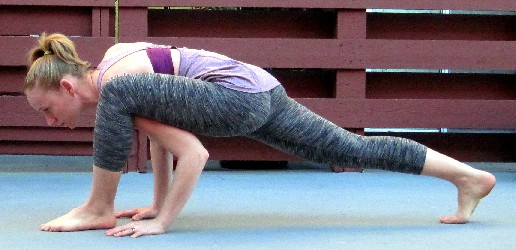
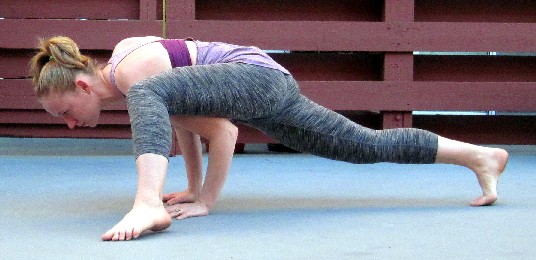
An arm balance by any other name would feel just as empowering, so let’s just call it scissors and move on! Begin in lizard with the left leg forward and the right leg back, both hands are on the big toe side of the front foot. Keep the front  knee bent right above the ankle. Keep the back knee lifted, lengthening the back leg and pressing back through the heel.

Lizard

Begin in Lizard.

If you feel a deep stretch, stay right here and enjoy it! If you’d like to go further, bend into the elbows, and bring the left arm underneath the left knee. Keep hugging that left thigh in toward the midline of your body. The closer you can get to drawing your shoulder underneath the thigh, the easier it will be to hold your arm balance. Now, plant the hands underneath the shoulders and draw the elbows toward one another. Your right elbow can either nestle in under the right hip to help support your body weight, or it can stay to the side of the hip for more of a challenge. As with any arm balance, keeping the arms parallel is key; if you let the elbows bow out to the sides, you will lose your support and fall out of the arm balance.

Eka Pada Koundinyasana II Prep

Draw the left shoulder underneath the left knee, sliding the left hand leftward.

Keeping the arms as they are and the left knee drawing in toward the midline, heel-toe the left foot to the left. You want to rotate the leg so that the big toe side of the foot is on the floor, and the inner thigh is resting on top of the upper arm. If you keep the hamstring (back of the thigh) on the upper arm, it becomes difficult to get into this posture without substantial flexibility.

Eka Pada Koundinyasana II Prep

Heel-toe your left foot to the left, rotating the left inner thigh onto the back of the upper arm.

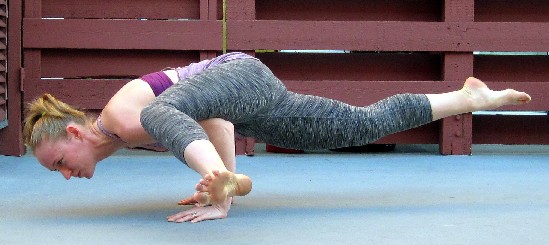
Now bend deeply into the elbows, draw the chest way out in front of the hands, and turn your gaze the left. If you shift the weight far enough forward, the back foot will gently float off the floor. Keep the back leg strong, pressing out through the ball of the foot and spreading through the toes. When you first experience this arm balance, your face may come quite close to the floor. As you become more stable, work on lifting up through the chest and drawing the shoulders back.

Eka Pada Koundinyasana II with Knee Bent

Bend the elbows deeply and shift the weight forward until the back foot floats off the floor.

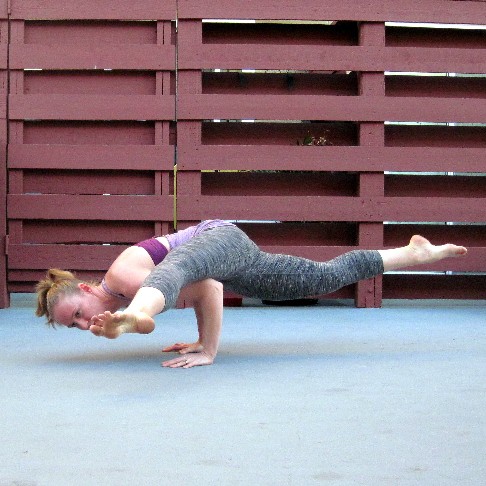
Once you become stable here, extend the left leg forward. Keep both legs strong, reaching out in opposite directions, to keep integrity in your arm balance. Keep your breath flowing and see if you can relax the face.

Eka Pada Koundinyasana II

Straighten into the front leg for full Eka Pada Koundinyasana II.

Gently release back to lizard and switch sides to prepare for “scissors” with the right leg forward.

Mindful Relationships: Your Piece of the Universe

When my husband and I were planning our wedding, we chose to write our own vows to make sure they really meant something to us. Easier said than done, especially after being immersed in a bunch of yoga philosophy! If you’re supposed to be responding to each moment as it comes and extending loving kindness indiscriminately to the whole universe, how is making a long-term commitment to any one person reconcilable with that? In search of some guidance, I went to a satsang with Shakti Mhi, which not only gave me inspiration for my wedding vows, it gave me a deeper understanding of what it meant to be in a relationship.

Shakti used an analogy to explain how your partner is your link to the rest of the universe. Imagine you travel out of the city one weekend for a remote lakeside getaway. On one of your nature walks, you are swept away by the beauty of a lush blossoming tree. It’s reflection shimmers off the glassy surface of the lake and the air is rich with the scent of flower petals. If only you could experience this beautiful scene every single day! You know it just wouldn’t be possible to drive out to the lake all the time, so as a souvenir of the blossoming tree, you cut off a small branch and place it in a vase of water. Once at home, set your piece of the blossoming tree on your kitchen counter where you can see it everyday. You tend to it diligently, making sure it always has fresh water and enough sunlight, keeping it nourished and healthy. In turn, the branch is your connection back to the tree by lake; every time you see the branch it is a reminder of the blossoming tree from which it came, and as you tend to it, you are tending to a piece of that complete tree.

In relationships, the tree is the universe and the branch is your partner. You are only one person and it is impossible to actively care for the whole universe all on your own. So, you take a piece of the universe home with you, your partner, and you tend to them, nourish them, and show them the loving kindness you would extend to the whole universe if you had the capacity. When you care for your partner, though them, you are caring for the universe. In turn, your partner is your window into the rest of the universe; through them, you experience the love, suffering, joy, and pain that exists in the rest of humanity. Through intimacy with them, you develop compassion, empathy, tolerance, oneness, and many more qualities which can then be extended to the rest of the universe.

Shakti explained how the yogic practices of  yantra, mantra, and tantra could be brought into relationships to build intimacy with your partner. Put simplify, yantra, mantra, and tantra are meditation practices based on visual images, sounds, and feelings, respectively. In order to truly know your partner, you have to approach them with a meditative mindset that sets aside expectations, prescriptions, and judgments so that you can perceive this person as they truly are. To really see your partner you must look at them without imposing on them your own desires about what you want them to be, fears about what they could be, or any other biases that cloud your perception. To truly hear your partner, you must set aside defensiveness and prejudgment, listening for what they are actually trying to express. To really feel your partner, you must broaden your perception to capture what they are communicating non-visually and non-verbally. It is only when you truly know your partner that you can effectively serve them.

At the end of the satsang, I asked Shakti what she would suggest I say as my wedding vows to foster this type of relationship. Her response: “Silence.” She said that wedding vows should not be a once in a lifetime thing. You should be actively choosing to make that commitment when you wake up every morning, every hour of the day, every moment.

My husband and I did come up with wedding vows to keep our ceremony somewhat normal, but we tried to write them in way that would foster the type of mindful relationship Shakti described. However, after attending the satsang, I realized that the words we chose for the vows would be insignificant compared to the continual commitments we would be making to each other every moment thereafter.