Turbo Dog

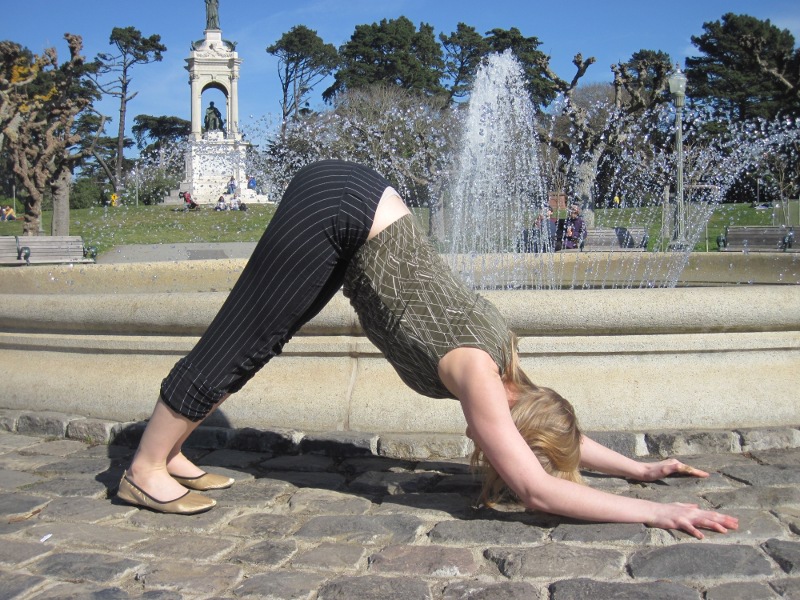
Nothing strikes fear into the hearts of yogis like adding “turbo” to the beginning of a pose’s name, and turbo dog probably deserves that apprehension. It is a variation on downward facing dog that targets the triceps (muscles in the back of the upper arms). Pretty simple instructions: start in downward facing dog, and as you exhale bend into the elbows so that they hover just above the floor. Don’t touch the elbows down or you lose the tricep strengthening. Contract the muscles in your shoulders, upper chest, and upper back to keep your elbows from bowing out to the sides; keep your arms parallel. Always keep the abdominals contracted, and, other than the variation in the arms, maintain good down dog form.

Turbo dog

Turbo dog

Twisty Balance Flow

In vinyasa or hatha flow classes, the magic comes as much from how you sequence the poses as from the poses themselves. I picked up this flow from Elizabeth, one of my favourite teachers in San Francisco. To get the full benefit of the postures, make sure to hold each one for three to five breaths.

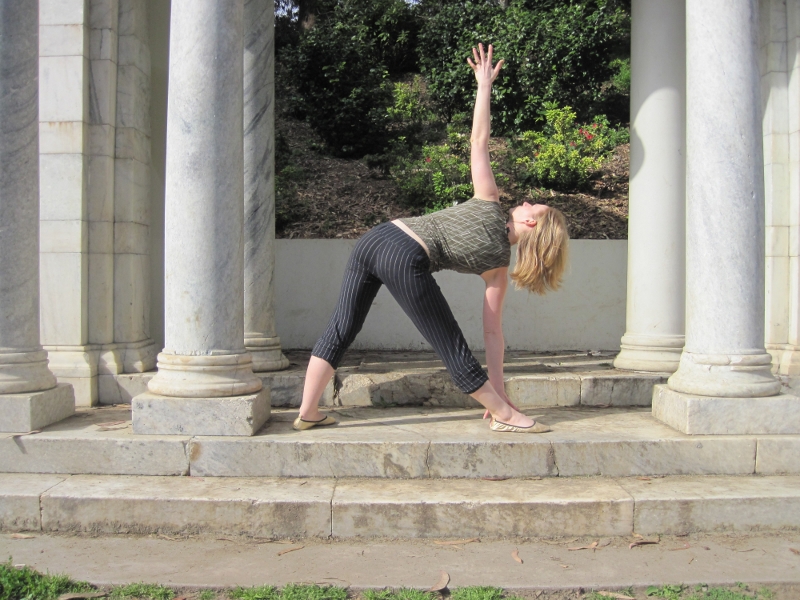
Start in triangle pose (trikonasana), making sure both sides of the torso (even the bottom side) are long. You can look down, to the side, or up, but really extend forward through the crown of the head. Think about rolling your top hip back. Breathe.

Triangle

Start in triangle pose.

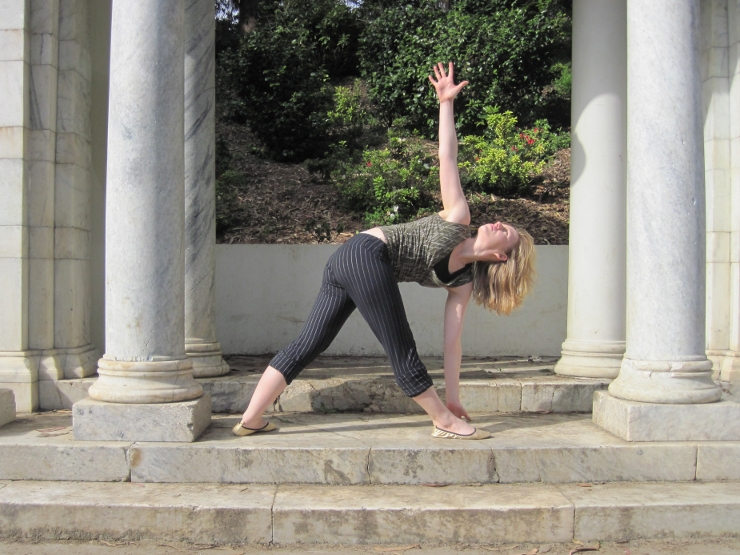
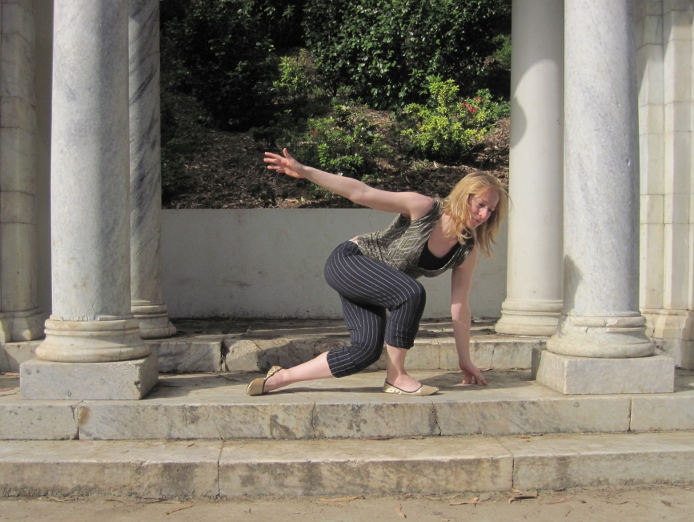
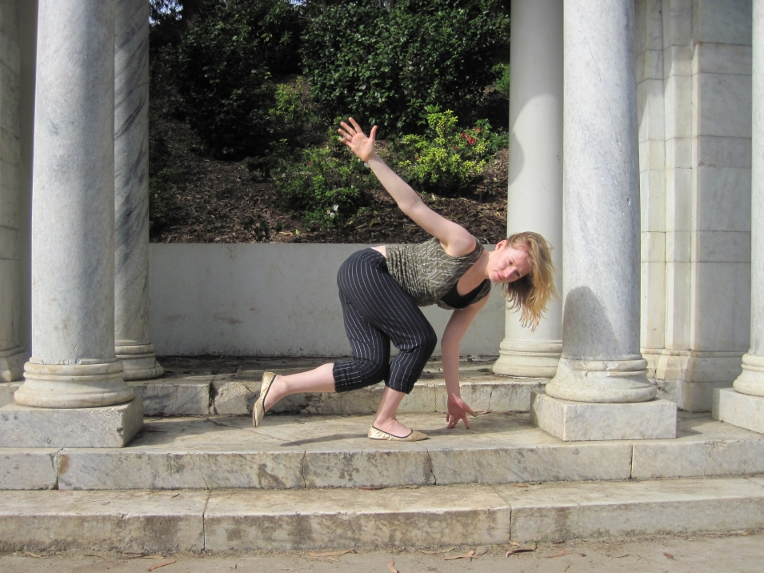
Prepare for revolved triangle (Parivrtta Trikonasana). As you exhale, bring the top hand to the ground or a block. As you inhale, take the other hand to the hip or extend it skyward, revolving the chest toward the front inner thigh. Keep both sides of the torso long. The head can look down, forward, or up. Breathe here.

Revolved Triangle

As you exhale, bring the top hand down to the ground or a block. As you inhale, extend into revolved triangle.

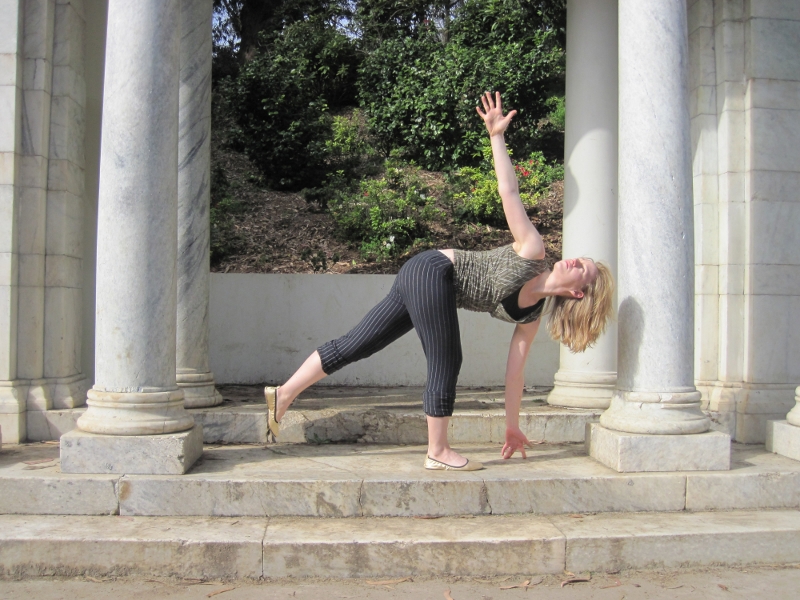
Prepare for revolved half moon (Parivrtta Ardha Chandrasana). Slightly bend the front knee and begin to shift the weight forward. Contract the abdominals and as you inhale, lift the back foot off the ground.

Transition from revolved triangle to revolved half moon

As you inhale, begin to lift into revolved half moon.

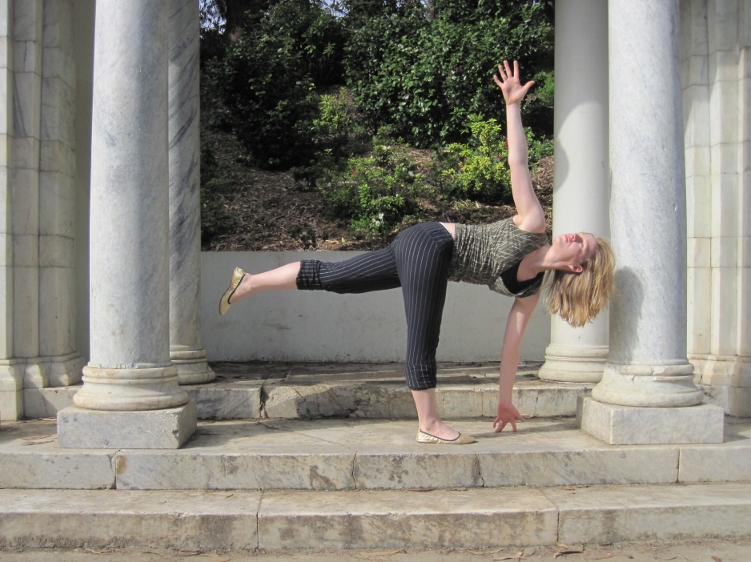
Keep the torso revolved; eventually the front of the chest may be completely perpendicular to the ground. The bottom hand can be on the floor or on a block, and the top hand can be on the top hip, or extended skyward. Try to get the back leg parallel to the ground with the foot flexed. Breathe.

Revolved half moon

Revolved half moon.

Prepare to transition to sitting. Contract your abdominal muscles, and as you exhale, bend into both knees. Bring the top knee behind of the bottom ankle, and sit down between the feet.

Transition to seated

As you exhale, transition from revolved half moon to a seated preparation for half twist.

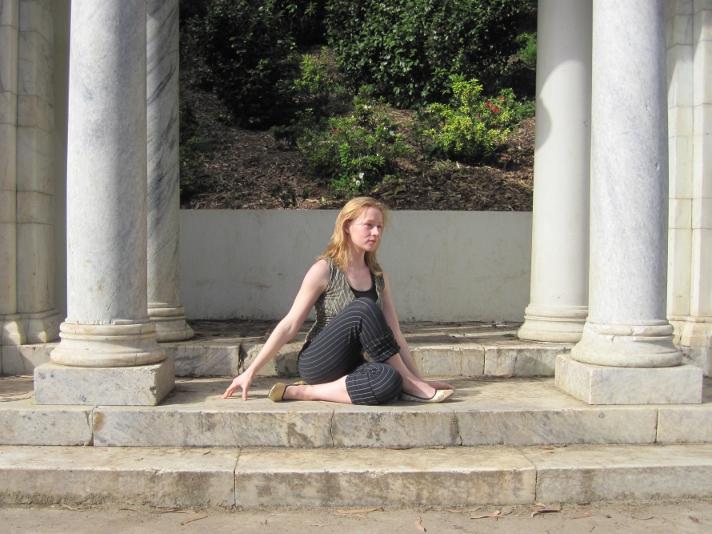
Make sure both sit bones are rooted, preparing for half twist (Ardha Matsyendrasana). As you exhale, turn the chest toward the top knee and place the back hand behind you. Inhale extend the other hand skyward, and then take the hand or elbow to the knee.

Seated preparation for twist

Prepare for half twist.

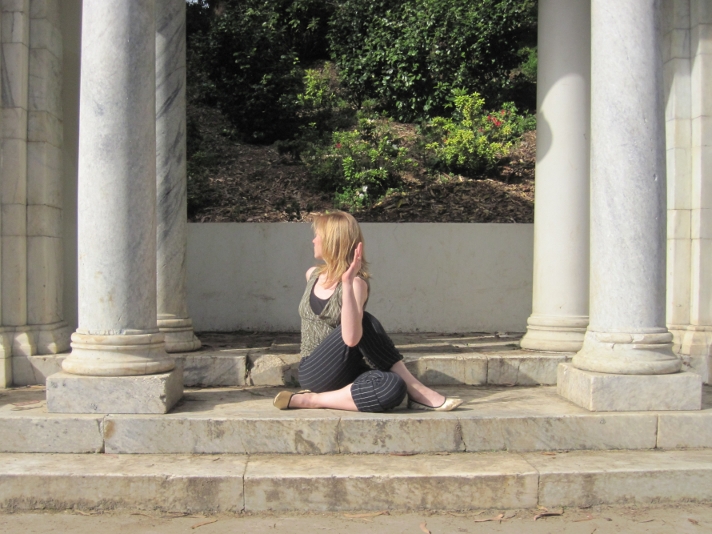
As you inhale lengthen upwards through the spine, as you exhale twist. Don’t only think about turning the head and eyes back, think about rotating the whole chest. Breathe here.

Half Twist.

Inhale lengthen upwards through the spine, exhale twist.

As you inhale, return the torso back to neutral, and prepare to return to a standing balance. Ground down through the foot of the top leg. Contract the abdominals, and as you inhale, begin to straighten that top leg leg and lift the other leg off the ground.

Return to standing

Inhale, return to standing.

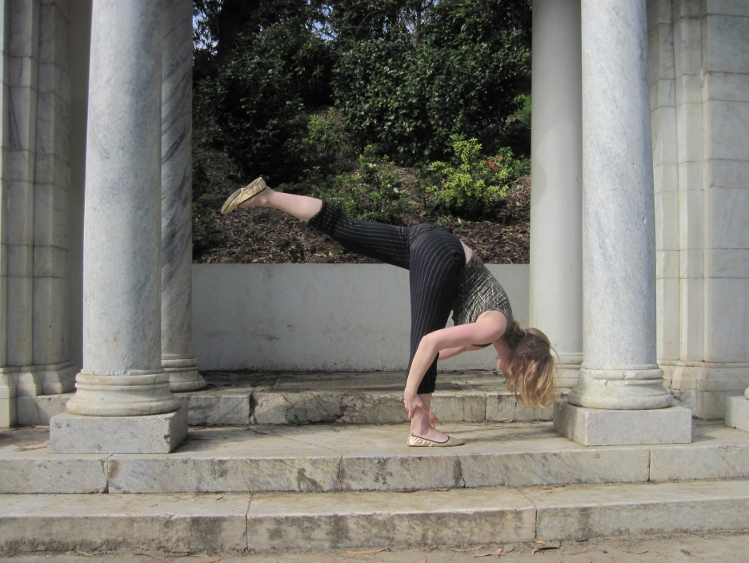
Transition into standing splits (Urdhva Prasarita Eka Padasana). It’s tempting to roll one hip higher than the other, but try to keep the hips square to the floor. As you inhale, lift the back leg up as high as possible while keeping the hips in alignment. If you have the flexibility, as you exhale, draw the chest in toward the quadriceps (front on the thigh). The hand can be on a block or on the floor, or you can have one hand or both grasping the ankle to challenge balance. Make sure to keep breathing.

Standing splits

Inhale, lift the back leg upwards. Exhale, gently pull the chest in toward the thigh.

I’ll let you decide where to go from here, but make sure you make your way to the other side to balance it out. For example, in a vinyasa class you could release half splits into a forward fold, step/hop back to chuttarunga and cycle through a vinyasa (upward facing dog, downward facing dog). From downward dog, you could then step forward into a lunge, giving you an easy transition into triangle pose on the other side. For the most balanced overall routine, you should make sure to enter triangle in the same way on both sides.

Monkey Tail

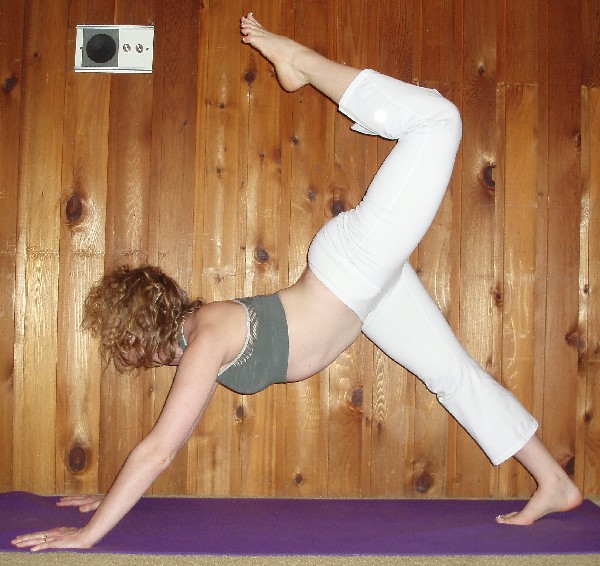
There are quite a few variations on hip flexion and extension flows from down dog. Here’s one called Monkey Tail. Start in Downward Facing Dog. As you inhale, lift one of the legs up toward the ceiling, bending into the knee as you lift. As you do this, pull the chest bone towards the front of your mat and look forward. Pay attention to the low back as having the knee bent makes it easy to arch the back too far. If you feel any discomfort, back off. As you lift the leg, head, and chest, you build strength and flexibility in the muscles along the whole spine.

Inhale lift the leg

Inhale, lift the leg

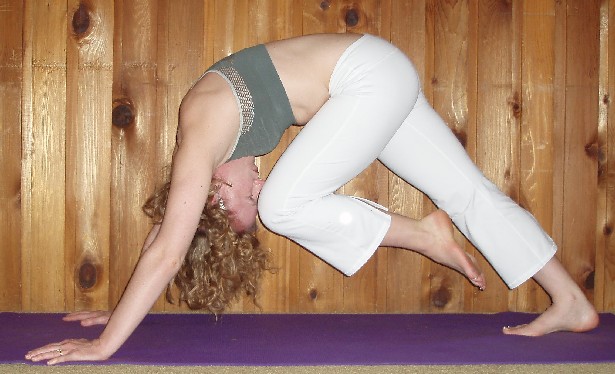
As you exhale, bring the knee in toward the nose, and nose in toward the knee. As you do this, you continue to work the low back muscle, and as you complete the crunch, you use your abdominal muscles as well.

Exhale, knee in toward to nose, nose toward the knee.

Exhale, knee in toward to nose, nose toward the knee.

Repeat for anywhere from 3-12 breaths, depending on how you’re fitting it into your practice. Make sure you balance it out on the other side!

Sex-Related Benefits of Yoga

I was recently asked to teach a sex-themed yoga class during an educational “sex week” at the university I graduated from. I instantly started coming with ideas for how I could relate yoga to sex, but sadly I was not available to actually teach the class. However, it inspired me to compile a list of ways that yoga can improve your sex life. Enjoy!

Cardiorespiratory Benefits

Not all styles of yoga include components that challenge your cardiorespiratory system, but if you practice a style that incorporates flowing sequences (e.g. vinyasa, power, etc.), these benefits may apply to you.

♥ Sun Salutations (and many other flowing sequences) are cardiorespiratory, or endurance, exercise. You may have heard that cardiorespiratory exercise improves risk of heart disease by decreasing build-up of cholesterol in the blood vessels. This makes partial or full blockages less likely. Did you know cardiorespiratory exercise also decreases risk of impotence? Without proper diet and exercise, cholesterol doesn’t only build up in the blood vessels that supply the heart, it also builds up in the blood vessels that supply the penis. Since an erection occurs when the penis becomes engorged with blood, unobstructed blood flow to the penis is vital to, ahem, solid performance. Cardiorespiratory exercise, such as sun salutations, may help decrease cholesterol build-up in these blood vessels, making it easier to “get it up.”

Stamina can be an asset in bed—nobody wants to be too exhausted to continue. The more cardiorespiratory exercise you do, the better your endurance will become. One of the reasons endurance improves is because your heart becomes stronger and more efficient at pumping oxygen around the body. No matter what kind of cardiorespiratory training you do, it will increase your endurance in other aerobic activities, such as sex. Another reason endurance improves is because more blood vessels grow to the muscles to increase the delivery rate of oxygen. The muscle also adapts to be able to use more oxygen towards producing energy. These adaptations don’t happen for all the muscles in the body, only the ones you use during your cardiorespiratory exercise. This means that runners have the best endurance when running, cyclists when cycling, and yogis when doing yoga. The movements in sun salutations are more similar to movements you’d use in the bedroom than, say, running or cycling (think about upward facing dog to downward facing dog; just sayin’). This means that doing Sun Salutations may be a more targeted way of improving your stamina in bed. Of course, the best way to increase sex endurance is to have lots of sex.

Body Awareness Benefits

♥ You’ve probably heard that size isn’t that important, it’s how you use it that matters. Well, in order to make the most of your assets, it is important to have precise control of your pelvis. This doesn’t only apply to the men; ladies, the angle of your pelvis has a huge bearing on which of your hot spots are hit and missed. As a yoga teacher, I know that many people who first come into a yoga class have a hard time with pelvis alignment. Even if you understand what it means to “tilt your sit bones back/up” or “tuck your tail bone under,” it can be hard for the brain to actually track down the combination of muscle contractions that achieves these movements. But, after doing enough cat-cow, you master these motions. In a diverse yoga practice, you learn to align your hips into a variety of positions, in all sorts of different body orientations. This improvement in body control undoubtedly carries over into your sex life, allowing for more directed, controlled gyrations in whichever position you choose to explore.

Strength, Flexibility, and Balance Benefits

♥ Most yoga classes improve core strength. Your core is composed of your abdominal muscles, your low back muscles, and your pelvic floor. Under normal conditions, you keep constant contraction in these muscles to stabilize the rib cage and pelvis and maintain that good posture I know you all have. During sex you contract and relax these muscles to move your hips. If your core is weak, you will tire out quickly. The pelvic floor muscles are not only related to balance and posture, they are intimately linked to the quality of an orgasm, control of ejaculation, and compression of the vagina (which makes it seem tighter).  If you’re not sure how to contract  your pelvic floor muscles, cough, and they’ll contract automatically (now just think *cough* *hold*). Any balancing postures work the core, since these muscles are responsible for stabilizing the torso. Postures like warrior 3 challenge the low back muscles, and postures like boat challenge the abdominal muscles. Planks and side planks will also challenge the core. Many styles of yoga have also adopted a number of targeted core exercises that really make you “feel the burn.” Make sure you contract the pelvic floor whenever you’re doing core work. This is the finishing touch many people forget.

♥ If your parter suggests sex in the shower, is your response, “Uhm, aren’t you afraid we’ll fall or something?” or “Put one foot on the side of the tub, and give me your other leg.” I’m not saying that shower sex is for everyone, but having strength, flexibility, and balance gives you the option to find out if it’s for you without getting injured. And, it gives you the option to try out any other positions or variations you’re interested in. There are so many possibilities that it would be impossible to assign you a specific “yoga for sex” sequence of poses, but a balanced yoga practice will make you more likely to be prepared for whatever piques your curiosity. Anyone want to borrow my copy of the Kama Sutra?

Psychological Benefits

Insecurities can get in the way of sexual expression. Physical activity programs have been shown to improve self-esteem and promote a positive body image. Maybe it’s because exercise makes you look healthier and more fit, maybe it’s because exercise causes feel-good hormones to be released in your brain. Either way, the better you feel about yourself, the more comfortable you will be to explore!

♥ Unlike many other programs that incorporate physical activity, yoga has a central focus on mindfulness—on being focused on the present moment, here and now. Many of us have busy lifestyles, and we’re used to constantly trying to plan three steps ahead and repeatedly analyzing decisions we’ve already made. Go-go-go mode is important for our daily achievements! But it sure makes it hard to get in the mood. In practicing yoga and meditation, we to learn how to turn all that off, even if just for a little while, and tap into the present moment. Bringing mindfulness into the bedroom improves intimacy in a way that you can only achieved when you have one another’s complete, undivided attention. If you’re interested in fostering a mindful connection with your mate, look for partner yoga classes in your area.

No wonder “I’m a yoga teacher” is such a great pick-up line!
Flying Crow

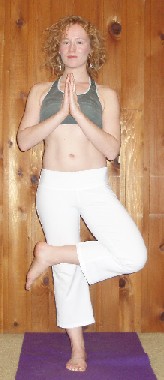
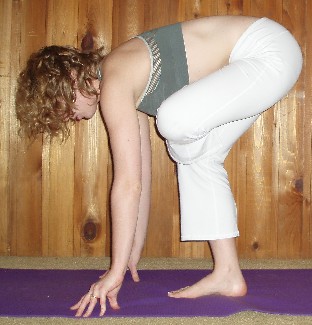
Variation on tree.

Variation on tree.

Once you’ve mastered crow pose, give flying crow (eka pada galavasana) a shot. It is important to have a good handle on crow first so that you know how to make micro-adjustments to stay balanced on your hands. Crow is much easier to escape from than flying crow if you start to fall.

When I teach this in my yoga classes, I usually transition into flying crow from a variation on tree. This gives people the option to stay in tree if that is a more useful balancing posture for them. So let’s start there. Begin in a variation on tree pose with your ankle crossed over the centre of the opposite thigh.

Bring the hands to the floor.

Exhale, forld forward and bring the hands to the floor.

Contract the abdominals, low back, and pelvic floor, and as you exhale fold forward, bringing the hands down to the mat. It is okay to bend into the knee of your supporting leg.

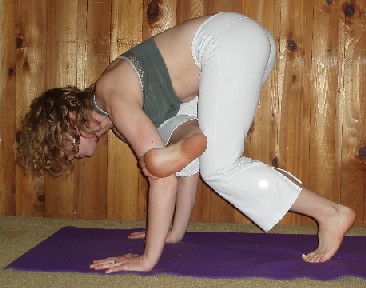
Now, bend into the elbows. Form a shelf with your tricpes (these are the muscles in the back of your upper arms). This shelf is the foundation of your posture; this is where the shin of your front leg is going to sit. The stronger your foundation, the more likely you’ll be able to stick the posture, so don’t let the elbows collapse inwards or outwards: the arms should stay parallel. Bring the shin to the triceps. You may need to hop the back foot farther back.

Bring the shin to the triceps.

Bring the shin to the shelf created by the triceps.

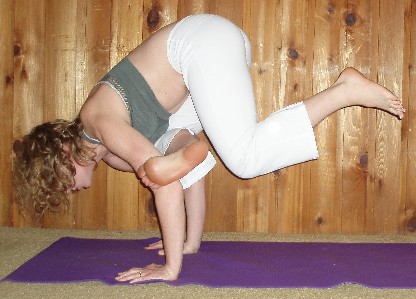
Like most arm balances, you don’t need to hop or jump to get into flying crow. Contract the chest and upper back muscles to keep the elbow from bowing out to the sides. Contract the abdominals, you’ll need them to maintain balance. Now, slowly bend into the elbows and reach the chest bone forward until your back foot floats off the floor. The slower you go, the easier it is to stick the arm balance. If you enter the posture with a lot of forward momentum it’s harder to stop right at that perfect balance point, and you’re more likely to fall forward onto your head. Also, try to look forward while you’re in this posture. Looking down or back toward the legs makes you more likely to roll forwards.

Shift the weight forward until the back foot floats off the floor.

Shift the weight forward until the back foot floats off the floor.

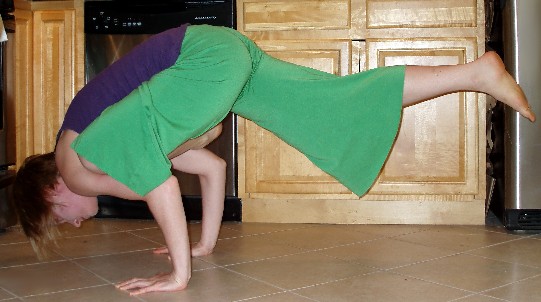
The last step is to slowly extend the back leg. Again, move slowly so that you don’t have to compensate for big changes all at once. For every change you make with that back leg, you have to adapt your foundation to maintain balance. Keep looking forward, keep the arms parallel, and keep the abdominals, low back, and pelvic floor contracted. Breathe.

Slowly extend the back leg.

Slowly extend the back leg.